Go back
  September 14 2026
In June 2025, two measuring instruments from the Polish company Svantek were sent to the International Space Station: the SV 104A noise dosimeter and the SV 971A sound level meter. The Axiom-4 mission, which included Polish ESA astronaut Sławosz Uznański-Wiśniewski, featured the Wireless Acoustics experiment dedicated to acoustic measurements aboard the station. Conditions on the ISS leave no room for error. The constant noise of fans and life-support systems remains at approximately 72 dBA, structural vibrations generate false sensor readings, and servicing capabilities are nonexistent. An instrument either operates reliably throughout the mission or becomes useless.
Svantek passed this test. Both devices underwent full calibration before launch and after returning to Earth in an accredited calibration laboratory compliant with PN-EN ISO/IEC 17025. Space conditions did not alter their measurement properties beyond even a fraction of the permitted tolerances.
This story may seem far removed from the reality of factory floors. But the distance is deceptive. A CNC machine operator on the night shift faces the same categories of stress as an astronaut: background noise exceeding 85 dB, vibrations transmitted from the machine to the control panel, electromagnetic interference generated by inverters and welding equipment, and temperatures reaching 40°C with humidity above 80%. The scale is different, but the logic is identical. An HMI interface—that is, the panel through which a person communicates with a machine—either works reliably under all conditions or causes downtime, operator errors, and costs that no one included in the budget.
Operator fatigue starts with the interface
For years, NASA has used the NASA-TLX (Task Load Index) questionnaire to measure the workload experienced by a person operating equipment. The questionnaire divides workload into six dimensions: physical, mental, temporal, performance, effort, and frustration. Independently of this assessment, astronauts also evaluate onboard equipment in terms of ease of use. Svantek dosimeters, lightweight and easy to attach to a spacesuit, received the highest ratings for unobtrusiveness—the ability of a device to operate without interfering with everyday activities.
On production floors, formal task-load assessments are rarely carried out, but the consequences of a poorly designed interface are identical: hand fatigue after eight hours of pressing stiff buttons, neck pain caused by constantly glancing at a panel mounted at the wrong angle, and frustration caused by the lack of confirmation that the machine has registered a command.
HMI ergonomics addresses these problems at the design level. Glass front panels combined with capacitive touchscreens reduce the load on the operator’s hands. Activating such an interface requires no pressure; bringing a finger close to the surface is enough. Foil keypads, meanwhile, can be less than one millimeter thick, allowing them to be mounted in a way that matches the operator’s natural hand position.
Mental workload is reduced by other design features. Membrane keypads with embossed keys and metal domes provide a tactile “click” beneath the finger—a clear confirmation that the system has registered a press. The operator does not need to look away from the monitored process. Touch alone is enough, so in environments where constant background noise already increases mental fatigue, quiet buttons eliminate additional acoustic stimulation.
The interface’s graphic layer can include certified Braille markings, enabling individual buttons to be identified without looking. LEDs integrated directly into the keypad’s multilayer structure inform the operator about process status through the color of the backlighting, without requiring data to be read from an external display.
In a technical specification, every control panel looks ergonomic. It is only on the night shift, with 85 dB of background noise and temperatures of 36°C on the factory floor, that it becomes clear which interface actually reduces the burden on the operator.
Protection against electromagnetic interference
Every additional cable on the International Space Station means additional mass, additional risk of electromagnetic loops, and potential interference with sensitive onboard equipment. That is why Svantek designed its instruments with wireless data transmission via Bluetooth. The compact, cable-free system underwent full electromagnetic compatibility verification on Earth, before the mission launch.
Factory floors are not orbit, but in terms of the density of interference sources, they can be equally demanding. Electric motors, frequency converters, arc welders, and induction systems. Each of these devices emits an electromagnetic field capable of disrupting the operation of a control panel. The result can be both mundane and dangerous: an unintended change in the machine’s operating mode, a false parameter reading, or an interface freezing at a critical moment in the production cycle.
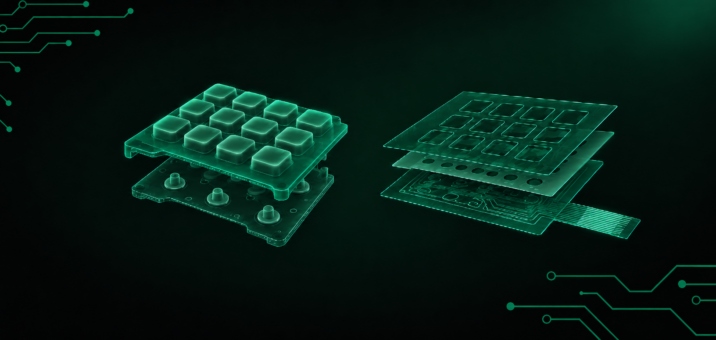
The answer to this threat is shielding integrated directly into the interface structure. Foil keypads consist of multiple layers of flexible polyester film on which conductive traces are printed using silver-flake-based ink. This multilayer structure can incorporate three types of protective shielding:
- ESD shielding – protects the circuit against electrostatic discharge, meaning a sudden transfer of electrical charge, for example from an operator’s hand to the panel;
- EMI shielding – blocks interference generated by electromagnetic fields from nearby machinery;
- RFI shielding – suppresses radio-frequency interference, for example from wireless communication systems operating in the factory.
The complete structure remains less than one millimeter thick. Shielding becomes part of the construction from the design stage, integrated with the rest of the keypad; it is not a separate component and therefore requires no additional mounting space. This makes it possible to achieve a thin, attractive device that is highly resistant to the electromagnetic interference expected in heavy industry.
Vibration, impact, and one million presses
During the Axiom-4 mission, one of the challenges was sudden structural movement aboard the space station, which could generate measurement artifacts—false readings unrelated to the parameter being measured. The Svantek team addressed the issue by introducing digital event markers activated during strong vibrations. This enabled analysts to identify and exclude disturbed sections of data precisely. Measurements remained reliable despite the unstable environment.
A factory floor offers no such comfort. An interface mounted on a vibrating machine either withstands the vibrations without losing functionality or, over time, begins generating false signals, losing electrical contact at connection points, or cracking around mounting locations. Traditional mechanical switches, built from moving springs, plates, and latches, are susceptible to these effects. Loose components resonate with machine vibrations, wear unevenly, and eventually fail.
Membrane and foil keypads have a different architecture. Instead of moving parts, they use flexible polyester film layers with conductive traces printed using silver-flake-based inks. No play, no springs, and no components capable of resonating. This construction makes them more resistant to continuous vibration and accidental impacts.
The construction itself is not enough, however. Before an interface enters series production, it must undergo laboratory verification covering three types of tests.
Vibration tests on specialized tables simulate operation near industrial machinery. The device is subjected to prolonged shocks at varying frequencies and intensities. Sensors monitor every electrical and mechanical connection for stability.
Impact tests reproduce situations in which an operator or an object strikes the panel with significant force. The equipment detects housing cracks, micro-deformations in the structure, and, above all, temporary interruptions in electronic operation at critical mounting points.
Fatigue testing follows a different procedure. A robotic system performs millions of pressing cycles on individual buttons using varying levels of force. Sensors record whether the activation force changes after one hundred thousand, five hundred thousand, or one million repetitions. They also verify whether the electrical contacts retain their conductivity.
Combining a flexible multilayer architecture with rigorous testing in accordance with ISO standards and military AQAP requirements results in an interface capable of operating around the clock on vibrating machinery without losing electrical or mechanical continuity.
Why a display loses readability after several months
Most standard display panels contain an air gap between the screen and the outer protective glass. Manufacturers refer to this construction as an “Air Gap.” At first glance, the difference appears cosmetic, but after several months in a demanding environment it becomes immediately visible.
Light refracts at every boundary between materials: glass, air, and the display. This reduces display contrast. Under intense factory lighting, reflections make parameters difficult to read. Moisture enters the gap, condenses on the display surface, and creates fog visible beneath the glass. In dusty environments, fine particles settle inside, and removing them requires dismantling the panel.
Optical bonding eliminates these problems. It involves joining the display, touch panel, and front glass using a liquid or solid optically clear adhesive applied across the entire contact surface. Once cured, the air gap no longer exists.
Display contrast increases because light no longer refracts at additional material boundaries. Reflections are reduced. Condensation and dust ingress become physically impossible because there is no space in which they can occur. The mechanical resistance of the display also increases: the optical adhesive creates an additional layer that helps absorb impacts.
Protection is complemented by coatings applied to the outer glass:
- Anti-Glare (AG) coating diffuses harsh reflections of light.
- Anti-Reflective (AR) coating suppresses mirror-like reflections.
- Oleophobic (Anti-Finger, AF) coating reduces the visibility of fingerprints on the touch surface.
Panels exposed to strong impacts use plastic or glass materials that meet IK ratings, which define enclosure resistance to impact energy expressed in joules.
In a technical specification, a panel with optical bonding and one with an air gap may look identical. After six months in a paint shop, exposed to solvent vapors and temperature gradients exceeding 40°C, one will remain readable. The other will not.
Repeatability of parameters in series production
Svantek’s history on the ISS provides another lesson, less spectacular but fundamental to every manufacturer. The instruments returned from orbit with parameters identical to those recorded before launch. Calibration in an accredited laboratory, performed in accordance with PN-EN ISO/IEC 17025, showed that all deviations remained within standard tolerances. The journey into orbit and back did not cause metrological drift—the gradual, uncontrolled change in an instrument’s measurement properties.
The question that follows from this is: how can a manufacturer guarantee that the ten-thousandth keypad leaving the production line has exactly the same parameters as the prototype approved by the designer? The answer comes down to three elements.
The first is 100% production inspection. Every individual keypad undergoes testing on a proprietary inspection station. The inspection covers the force required to activate each button, the number of pressing cycles, the correct installation of LEDs, resistors, and printed circuit boards, as well as spectrophotometric color matching of the graphic front to an approved laboratory reference. The customer receives the finished product together with an individual test report. Sampling-based quality control, standard in many branches of industry, is not used here.
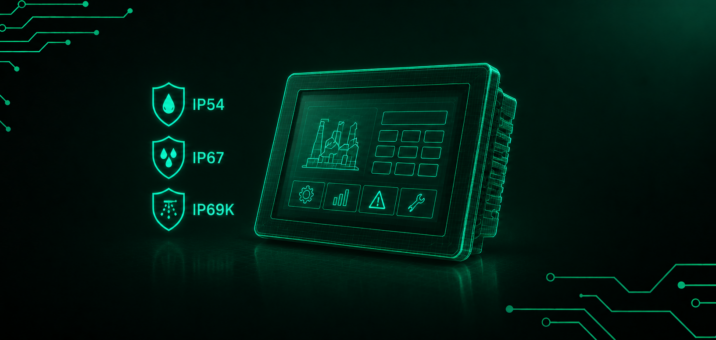
The second element is environmental simulation. Prototypes and series products are placed in climatic chambers, where they are exposed to temperatures ranging from -40°C to +80°C. Sealing tests are performed in accordance with IP standards, including IP68, which requires full sealing under pressurized water exposure and during prolonged immersion. Dust chambers verify that fine solid particles do not penetrate the structure.
The third is an in-house research and development laboratory equipped with testing and measurement equipment. The laboratory supports the continuous improvement of formulations for paints, coatings, conductive inks, and substrates, as well as the study of finished interfaces under simulated extreme loads. As a result, the manufacturer is not dependent on external testing bodies, and iteration time is reduced from weeks to days.
How does this work at Qwerty?
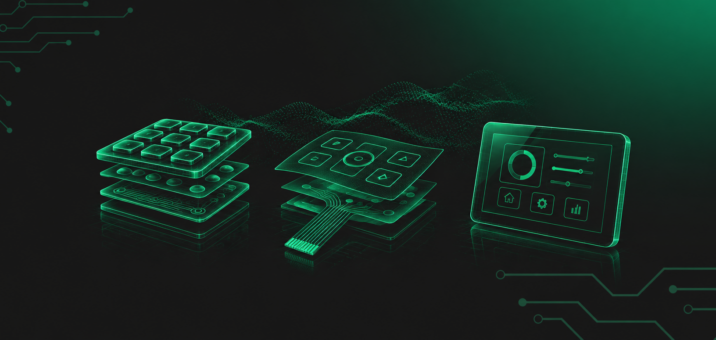
Qwerty treats every HMI interface project as a system in which no element functions independently of the others. The choice of activation technology—membrane, capacitive, or hybrid—results from an analysis of the target environment, operator workload profile, and applicable standards. Decisions regarding EMC shielding, the type of optical bonding, or the IP rating are made at the specification stage, before the first prototype is built.
The company operates its own research laboratory, where it tests new substrates, paints, conductive coatings, and printing technologies. Every prototype undergoes climatic testing from -40°C to +80°C, vibration and impact testing, IP68 sealing verification, and electromagnetic compatibility testing with ESD, EMI, and RFI shielding.
Series production is subject to full quality control. Every keypad leaving the production line is tested on a proprietary inspection station for button activation force, electrical contact stability, correct installation of electronic components, and color consistency of the graphic front against the approved reference. Procedures comply with ISO standards and NATO AQAP requirements used in the defense industry.
Qwerty’s annual nonconforming-product rate is 0.24%. An industrial keypad can be purchased from many suppliers, but we deliver a solution that has undergone full laboratory verification before reaching the production line.
Svantek’s instruments returned from the International Space Station with parameters unchanged by rocket launch, cosmic radiation, or structural vibrations aboard the station. This result was the consequence of decisions made during the design stage and procedures implemented during production. An industrial interface does not have to travel into orbit, but it should be designed as if it might.