Go back
 October 26 2026
Imagine an automotive components plant with forty-five CNC machines. Some date back to the 1990s, while others are much newer. Controllers with no network ports operate alongside a cloud-based analytics dashboard that calculates machine efficiency in real time. Two worlds share the same factory floor: analogue and digital. Yet they are connected by the operator panel through which people enter data into the system.
The digital transformation of manufacturing rarely starts with an algorithm or a cloud server. It starts at the point where an operator interacts with a machine. The HMI (Human-Machine Interface) and its physical input layer determine whether the data reaching supervisory systems can be trusted. When the interface fails, the entire IoT/SCADA architecture loses its foundation.
From the perspective of an engineer responsible for production continuity, the reliability of an operator panel matters just as much as network stability or the accuracy of an analytics algorithm — and sometimes even more, because the panel affects the quality of information at its source.
Operator Panels in the Industry 4.0 Era
Just over a decade ago, an HMI panel had one main function: displaying the machine’s status. Temperature, rotational speed, cycle status. The operator checked the information, responded and returned to other tasks. Today, the same panel collects sensor data, processes it locally using edge computing (processing data directly at machine level rather than sending it to a central server first) and forwards it to higher-level systems: MES (Manufacturing Execution System), ERP (Enterprise Resource Planning) and cloud analytics platforms.
To communicate with other systems, panels use protocols such as MQTT (a lightweight publish-subscribe messaging standard designed specifically for IoT devices) and OPC UA (an open protocol that enables secure data exchange between devices from different manufacturers). Process visualisation can be made available through a web browser using HTML5 and SVG, allowing operators and managers to monitor production from a smartphone, tablet or even a smartwatch.
Every manufacturer’s brochure claims that its panels “support IoT”. After several months on the factory floor, however, it becomes clear which interfaces can withstand actual industrial conditions and which were designed primarily to look impressive in a sales presentation.
From the Controller to the Cloud
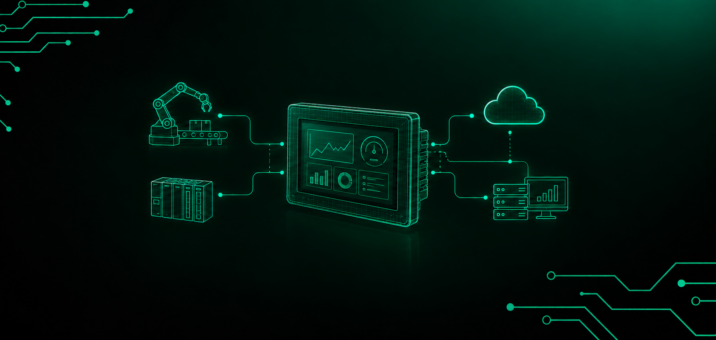
Production data travels from a machine sensor through the PLC (Programmable Logic Controller), which controls the process, to the HMI panel and then to supervisory systems such as SCADA and MES. From there, it may be sent to a cloud analytics platform. At every stage, information can be lost, delayed or distorted.
The connection architecture varies depending on the size and age of the plant. In a simpler configuration, the SCADA system reads data directly from the PLC to which the panel is connected. In a more advanced setup, the HMI itself acts as an IIoT (Industrial Internet of Things) gateway: it aggregates data from multiple sources, performs preliminary processing and sends it to an MES database or the cloud. Data can be transferred via a REST API (an interface for automated data exchange), FTP (for file transfers) or SQL queries (for database communication).
Physically, panels connect to the plant’s network infrastructure most often through Ethernet ports (RJ45), and less frequently through legacy serial interfaces (RS-232, RS-485) or USB. Data exchange protocols form a separate layer:
- OPC UA provides secure, cross-platform communication between devices from different manufacturers.
- MQTT minimises network overhead when transmitting data to the cloud.
- Modbus TCP or RTU is a simple, widely used standard for connecting panels to PLCs.
- Profinet, EtherNet/IP and EtherCAT support real-time communication in plants with more complex infrastructure.
The chosen architecture determines who within the organisation controls the flow of production data and how quickly information about an anomaly reaches someone able to respond. Data that travels too slowly leads to decisions made too late. An overly complicated data flow leads to decisions based on incorrect information.
Communication, Power Supply and Diagnostics
Most delays in scalable distributed systems originate in the communication layer — that is, in the way devices exchange information. The greatest challenge in this area remains hardware diversity. Plants operate machines from a dozen or more manufacturers, each using its own, often proprietary, protocol.
One solution is to migrate to open standards such as OPC UA and MQTT. However, when dealing with machines built twenty or thirty years ago that lack digital interfaces, this requires retrofitting: equipping older machines with external sensors for current consumption, vibration and temperature, as well as IoT gateways that convert analogue signals into digital data. Where running cables is difficult, wireless technologies become an option, including LoRaWAN (a long-range, low-power network) and industrial 5G networks designed to provide low latency.
Another challenge is connecting IT and OT networks — office infrastructure and production infrastructure, respectively. This creates both data fragmentation issues and cybersecurity risks. The architecture must therefore rely on network segmentation (dividing the network into separate zones using technologies such as VLANs), DMZs (demilitarised zones that provide a security buffer between internal and external networks) and firewalls that isolate control systems from internet traffic.
In Industry 4.0, power supply is no longer simply a matter of plugging in a cable. Power over Ethernet (PoE) allows data and power to be transmitted over a single twisted-pair cable, usually Category 5e or 6. This simplifies installation and reduces the number of potential points of failure. UPS systems and data buffering during voltage drops help prevent information loss during sudden power interruptions. IIoT devices must also withstand surges, electromagnetic interference and extreme temperatures — as well as salt, moisture and chemicals. These are conditions in which consumer electronics might not last a week.
Diagnostics is evolving from a reactive model — repairing equipment after a failure — towards a predictive one. Predictive maintenance relies on vibration and temperature sensors integrated with the HMI. These monitor the machine’s operating characteristics and flag anomalies before a physical failure occurs. Despite the clear benefits, relatively few companies collect and analyse diagnostic data from their machines comprehensively.
From April 2026, with the entry into force of the Polish legislation transposing the NIS2 Directive, responsibility for the cybersecurity of OT systems, including SCADA and HMI panels, rests directly with company management boards. Diagnostics and cybersecurity have moved beyond the maintenance department and onto the boardroom agenda.
The Interface Manufacturer’s Role in an IoT Project
An HMI component manufacturer that supplies a panel without integration guidance leaves the customer with a puzzle and no instructions. In an IoT project, the manufacturer’s role extends far beyond delivering the physical hardware.
The first capability it must provide is support for multiple protocols and interoperability between systems. Modern HMI panels integrate hundreds of communication drivers because a single plant may contain machines from a dozen or more manufacturers, each using a different data exchange standard. A panel supporting only one protocol restricts the project instead of simplifying it.
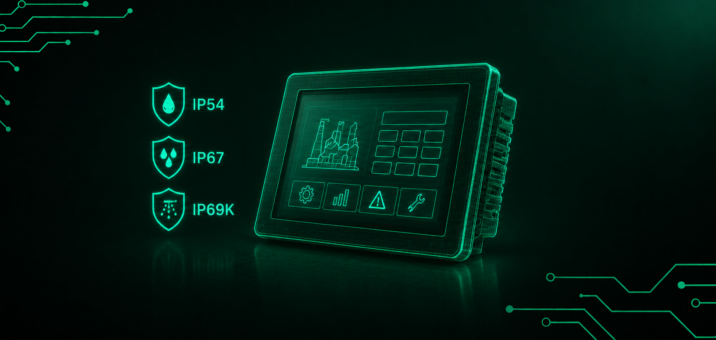
The second capability is environmental durability. This includes IP65 and IP67 ratings and, in the food industry, IP69K protection against high-pressure, high-temperature washdown; resistance to electromagnetic interference; and operation in temperatures ranging from well below freezing to several dozen degrees above zero. An interface that cannot withstand factory-floor conditions becomes a weak point in the entire supervisory architecture.
The third capability is bridging the skills gap between IT and OT. Automation engineers who have spent years programming PLCs must now work with protocols and architectures originating in enterprise IT. Conversely, IT specialists designing cloud systems do not always understand the specific requirements of production networks. A manufacturer that provides documentation, training and integration support alongside its hardware can genuinely accelerate implementation and reduce the risk of errors at the boundary between these two worlds.
One further role is often overlooked: supporting the modernisation of older machines. Gateways and converters that connect legacy serial ports to modern Ethernet networks, together with Pass-Through functionality (remote PLC programming through a connected panel), are essential tools. Without them, retrofitting older equipment could be impossible or economically unviable.
Where Does the Interface Determine Production Continuity?
The automotive components manufacturer introduced at the beginning of this article upgraded forty-five older CNC machines with IoT sensors and operator panels. The result was an increase in OEE (Overall Equipment Effectiveness) and a reduction in unplanned downtime. The gains came from making data collected at the physical interface available to people and systems capable of acting on it.
On automated assembly lines, SCARA robots (fast robotic arms used for pick-and-place, soldering and packaging operations) synchronise their movements with conveyor speed. Operators respond through HMI panels without stopping the line. An interface failure in this environment can halt the entire production line, not just one workstation.
In the pharmaceutical industry, supervisory systems maintain digital batch records, ensuring full traceability for every medicine batch. A membrane keypad resistant to pressure washing eliminates separate input devices and reduces the risk of errors caused by manually re-entering data. Where patient safety is at stake, the physical interface becomes part of the quality system.
In intralogistics, HMI panels installed on forklifts and integrated with a WMS (Warehouse Management System) automatically direct operators to the correct storage location. Numeric keypads are used to enter access codes, order parameters and picking confirmations. An input error can result in the wrong goods being dispatched.
How Do We Approach This at Qwerty?
At Qwerty, we treat the input interface as part of the overall system architecture, rather than as a standalone component ordered from a catalogue. Every project involving a membrane, foil or numeric keypad designed to work with an HMI panel begins with an analysis of the environment in which the device will operate.
We take into account:
- The required IP rating, electromagnetic compatibility (EMC), operating temperature range and the types of chemicals present in the environment.
- Dimensions, mounting method, connector types, and integration with the enclosure and display window.
- The risk of operator error during extended shifts, the readability of labels and the force required to activate buttons.
- Expected service life, planned upgrades and potential changes to the system architecture.
- Industry-specific requirements, including HACCP procedures in food processing, AQAP quality-assurance requirements in the defence sector and cleanliness standards in pharmaceutical manufacturing.
A factory floor in Silesia, with machines dating back to the 1990s standing alongside a cloud-based analytics dashboard. This image captures the essence of Industry 4.0: it begins at the point where an operator enters data into the system. If that point is poorly designed, the entire architecture rests on a fragile foundation. That is why we treat the physical interface as an integral part of the system’s design.