Go back
  October 8 2026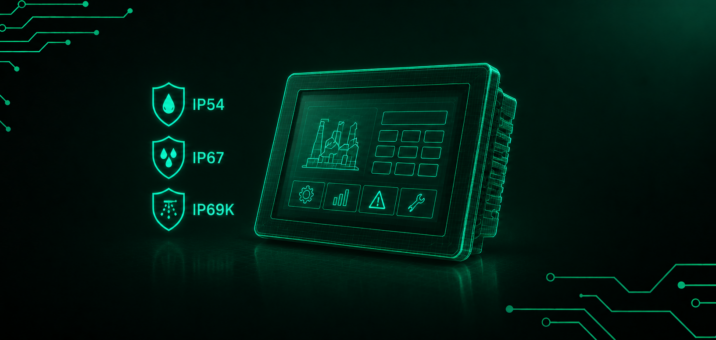
Monday, six in the morning, a production hall, the end of the overnight cleaning after the weekend shift. The cleaning crew is moving a high-pressure hose along the production line. The water jet catches the control cabinet and hits the operator panel mounted in its front. The panel is marked IP54, selected based on the datasheet because “that’s enough.”
On Tuesday, the line is down — not because the controller managing the machines has failed or because a motor has burned out. The operator panel (a device with a touchscreen through which the operator controls the production process) has stopped responding after contact with water it was not designed to withstand.
The IP protection rating (Ingress Protection, literally “protection against ingress”) is a parameter that takes up half a line in a specification, but the two digits following the letters “IP” define the boundary between what the panel can withstand and what will bring it down. On a production floor, that can determine whether the device survives its first encounter with the realities of a particular plant.
Two Digits, Two Protection Scales. Neither Tells the Whole Story
The IP rating is defined by the international IEC 60529 standard. Two digits follow the letters “IP”. The first digit (on a scale from 0 to 6) indicates protection against the ingress of solid objects, including dust. The second digit (on a scale from 0 to 9K) concerns protection against water.
The first digit increases from zero (no protection) through protection against objects of progressively smaller diameter to level 5, which allows limited dust ingress, and level 6, which indicates complete dust-tightness. The difference between five and six may seem minor on paper. On a production floor where process dust remains airborne throughout the shift, however, that one digit can translate directly into the service life of the electronics hidden behind the panel.
The second digit covers a wider range and more complex scenarios. Level 4 protects against water splashes from any direction. Level 5 withstands a water jet with a flow rate of 12.5 liters per minute. Level 6 handles a jet with a flow rate of 100 liters per minute. Beyond that, different rules apply: 7 indicates temporary immersion (up to 30 minutes at a depth of one meter), 8 indicates continuous immersion under conditions specified by the manufacturer, while 9K indicates resistance to high-pressure cleaning at 80–100 bar and temperatures of up to 80°C.
One detail regularly leads to design errors: ratings 7, 8 and 9K are not hierarchical with respect to ratings 1–6. A device certified to IP67 (immersion) does not necessarily meet IP65 requirements (water jets). If a panel needs to withstand both scenarios, the manufacturer must confirm this with a dual rating, such as IP65/IP67. The letter “X” in place of a digit (e.g. IPX4) indicates that the relevant parameter has not been tested or is not required.
The IP code also says nothing about resistance to chemicals, corrosion or condensation. A panel rated IP69K may not survive contact with an aggressive detergent if the enclosure and seal materials are not compatible with it. Chemical resistance must therefore be verified separately, regardless of the digits shown on the nameplate.
IP54. Protection Against Dust and Splashes, but Not Cleaning
The digit 5 means that dust may enter the device, but only in an amount insufficient to interfere with its operation. The digit 4 protects against water splashes from any direction, but not against water jets or cleaning.
IP54 is a standard choice for devices operating indoors. It works well in control cabinets on production floors with elevated dust levels, mechanical workshops, warehouses and assembly stations located away from wet areas. In hazardous locations (Class I, Division 2), regulations require a minimum IP54 rating for installed equipment.
The trap lies in perception. Two digits above zero, with both “fives” or “fours,” sound reassuringly robust. To someone without design experience, IP54 may look like a safe choice. The problem becomes apparent when the plant’s cleaning procedure involves anything more intensive than a damp cloth. One jet from a floor-cleaning hose, one careless splash while cleaning an adjacent workstation, and an IP54 panel can lose functionality because it was selected for an environment that nobody properly analyzed.
IP54 works well where water appears accidentally, for example in a workshop where someone spills coolant or in a warehouse where rain gets in through a leaky gate. In these scenarios, IP54 is a rational choice because it provides protection appropriate to the environment without unnecessarily increasing construction costs. But where cleaning is part of the schedule rather than an accident, IP54 is no longer sufficient.
IP65 and IP67. The Boundary Between Water Jets and Immersion
IP65 means complete dust-tightness (digit 6) and resistance to a water jet with a flow rate of 12.5 liters per minute from any direction (digit 5). In the context of HMI operator panels (Human-Machine Interface, an interface that allows an operator to control a machine), this is one of the most common ratings for fronts mounted in control cabinets. An IP65-rated panel front withstands direct jet cleaning. The rear of the panel, protected by the cabinet, usually has a lower rating (e.g. IP20) because it is not exposed.
IP65 applications are broad: industrial automation, outdoor monitoring, interfaces in food processing, where workstation cleaning is a daily procedure. In medicine and laboratories, IP65 allows regular disinfection with liquids without risking damage to the electronics. HMI panels equipped with industrial keypads with an appropriate protection rating maintain a sealed front even with daily exposure to water and detergents.
IP67 takes protection to another level: complete dust-tightness plus resistance to the effects of temporary immersion to a depth of one meter for 30 minutes. This is a common rating for industrial sensors, mobile IoT terminals (Internet of Things, a network of physical devices connected to the internet), vehicle keypads used in construction and agricultural machinery, marine components exposed to wave wash and interfaces in rail vehicles cleaned under pressure.
The difference between IP65 and IP67 is not linear and does not result from simply “adding” protection. IP65 protects the panel against what is sprayed onto it. IP67 protects it against what it may end up immersed in. If water exposure is controlled (regular cleaning according to a defined schedule), IP65 or IP66 is usually sufficient. If water exposure is unpredictable (flooding, waves, rain in an open environment), IP67 is the safer choice.
IP69K. Where Pressure and Temperature Change the Rules
IP69K is the highest rating in the IP scale. The letter “K” comes from ISO 20653, originally developed for road vehicles (the former German DIN 40050-9 standard), and indicates a test procedure separate from the standard IEC 60529 scale. A device with this rating withstands high-pressure water cleaning at 80–100 bar, at temperatures of up to 80°C, from a distance of 10–15 centimeters, at four spray angles (0°, 30°, 60° and 90°). In the food and pharmaceutical industries, where daily high-pressure hot-water cleaning is a standard hygiene procedure, IP69K is the minimum requirement.
A common mistake is to treat IP69K as a “better version of IP67.” These two ratings address different hazards. IP69K concerns resistance to pressure and temperature. IP67 concerns resistance to immersion. A device rated IP69K without dual certification may not withstand temporary immersion. In environments where both high-pressure cleaning and flooding risk occur, a dual IP67/IP69K rating is required.
In the food industry, IP69K often goes hand in hand with HACCP (Hazard Analysis and Critical Control Points, a system for analyzing hazards and critical control points in food production). This is an environment where the sealing of a membrane keypad can determine whether a workstation is fit for operation just as much as the enclosure material or the quality of its seals.
Choosing an IP Rating Is a Design Decision
The instinctive approach is to choose the highest available rating because more protection supposedly means less risk. This reasoning is flawed on several levels. A higher IP rating means a more expensive device, a heavier construction, more complex installation and more limited service access to the interior. Materials that meet IP69K requirements are not necessarily compatible with the chemicals used at a particular plant. Over-specifying protection creates additional cost without a proportional benefit, so before a specific IP rating appears in the specification, three questions should be asked:
- What does the cleaning procedure look like in the given environment? Dry wiping, jet cleaning, high-pressure cleaning at elevated temperatures? The answer determines whether IP54, IP65 or IP69K is sufficient.
- Does water appear in a controlled or unexpected manner? Regular cleaning is a different scenario from accidental flooding. The former requires resistance to water jets (IP65 or IP66), while the latter requires immersion resistance (IP67).
- Which chemicals come into contact with the device? The IP code does not cover chemical resistance. An IP69K panel installed in an environment where aggressive detergents are used requires separate verification of enclosure and seal materials (e.g. 316L stainless steel, EPDM seals).
The table below compares popular IP ratings in the context of operator panels:
| IP Rating | What It Protects Against | Typical Applications |
|---|---|---|
| IP20 | Protection against finger contact; no protection against water | Office equipment, electronics in dry indoor environments |
| IP54 | Limited dust ingress, water splashes from any direction | Workshops, warehouses, indoor control cabinets |
| IP65 | Complete dust-tightness, 12.5 l/min water jet | HMI panel fronts, outdoor monitoring, automation |
| IP67 | Complete dust-tightness, immersion up to 1 m for 30 min | Industrial sensors, mobile terminals, marine components |
| IP69K | Complete dust-tightness, cleaning at 80–100 bar and up to 80°C | Food industry, pharmaceuticals, workstations with daily disinfection |
The table shows what the enclosure can withstand, but not what the keypad, seal or graphic overlay installed in that enclosure can withstand — and these are often the components that fail first.
How We Approach It at Qwerty
At Qwerty, we treat the IP rating as a resulting parameter. Before discussing specific figures, we analyze the environment in which the interface will operate. A membrane or foil keypad installed in an HMI panel is an element on which the sealing of the entire front depends. If this element fails, the panel’s IP rating becomes a declaration without substance.
For every project, we consider:
- the operating environment and cleaning procedures used at the customer’s facility,
- the required IP rating for the front and rear of the panel,
- chemical compatibility with the detergents used to clean the workstations,
- the balance between sealing and tactile response, including button actuation force and tactile feedback for the operator (the perceptible confirmation that a button has been pressed, commonly referred to as a “click”),
- selection of layer materials: PET polyester films with a thickness of 75–200 µm, stainless-steel metal domes providing clear press confirmation, and polyurethane coatings protecting the printed graphics.
Most interface suppliers declare an IP rating based on a standard construction. Few ask which detergent a plant uses to clean its workstations or whether that detergent will degrade the seal after six months of operation. From our perspective, this should be one of the first questions asked.
The panel at the beginning failed because its IP rating was selected based on a general specification, without asking what everyday conditions on the production floor actually look like. That is why we start every discussion about the keypad and operator panel with a question about the cleaning procedure.