Go back
  October 8 2026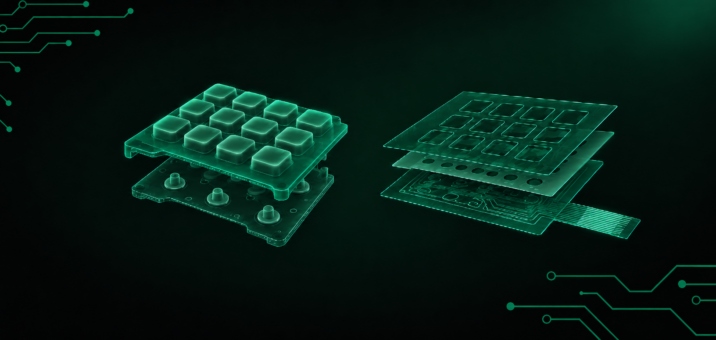
On the production floor of a meat-processing plant near Poznań, an integrator is finishing the installation of a control panel for a new packaging line. Stainless steel housing, a PLC controller, sealed connectors, temperature sensors—every component has been selected to meet HACCP hygiene requirements and withstand daily cleaning with alkaline foam. The operator interface—the element that a production worker presses several hundred times per shift—is selected with a single sentence: “Let’s use something flat and sealed.” A year later, the graphics on the panel begin to peel, the buttons lose their legibility, and the production manager stops the line to replace it.
This scenario is repeated across dozens of industries. The control panel may look insignificant compared with the machine as a whole, yet it is precisely this component that determines the ergonomics, hygiene, and reliability of the human-machine interface. The choice between a silicone overlay and a membrane keypad is not simply a matter of thickness or price.
Both solutions have different strengths, and neither is “better” independently of its context. The problem begins when an integrator makes the decision based on a component catalogue rather than an analysis of the operating conditions.
Construction and operating principle of a silicone overlay
A silicone overlay, also known as a silicone keypad or silicone rubber keypad, is a flexible interface molded from silicone that, at first glance, resembles a rubber cover. Its construction is based on several elements.
The top of the key, known as the keytop, is the visible surface pressed by the operator. Compression molding—the process of pressing silicone in a steel mold under high temperature—makes it possible to give the keytop almost any 3D shape: concave, convex, multi-level, and even several centimeters high.
Below the keytop are the sidewalls, known in the industry as the web. This is the thinnest part of the structure and, at the same time, the element that determines the button’s operating characteristics. The angle and length of the web determine the activation force (from 20 to 500 cN, ranging from a very light touch to pronounced resistance) and determine whether the operator will feel a mechanical “click” when pressing the button.
Below this is the base, which connects individual buttons into a single mat while also sealing the device once mounted in the housing.
The underside of each key contains a contact element responsible for closing the electrical circuit. Three variants are most commonly used:
- Carbon pill – made of silicone with an added carbon compound that conducts electricity.
- Metal pill – provides very low contact resistance and is used where high signal precision is required.
- Conductive paste – applied by screen printing and used as a lower-cost alternative in applications with less demanding requirements.
The surface of the overlay can additionally be coated with polyurethane (PU) lacquer to increase abrasion resistance or with epoxy resin to create a hard-plastic effect. A third option is laser engraving, which makes it possible to create backlit legends.
The operating principle is simple. At rest, the sidewalls keep the contact element away from the conductive traces on the printed circuit board (PCB). When the operator presses the key, the sidewalls buckle rapidly, creating a characteristic snap—a sudden movement felt under the finger as a “click.” The contact element hits the contact pads on the PCB or film, closing the circuit and generating a signal for the device. Once the pressure is released, the elasticity of the silicone immediately returns the key to its original position.
Silicone overlays can work with various electrical substrates. They can be mounted directly onto a PCB, providing the most stable and durable configuration for complex interfaces. They can also serve as a decorative and mechanical overlay on a membrane keypad, creating a hybrid solution. A third option is integration with metal domes, where the silicone acts as a plunger and the spring-loaded metal dome generates a firm, distinct “click.”
Construction and operating principle of a membrane keypad
A membrane keypad is a completely different construction. Where silicone uses a three-dimensional molded structure, a membrane keypad relies on precisely arranged layers of thin polymer films. The result is a flat, sealed panel between 0.5 and 1.5 mm thick, with the electrical circuit integrated directly into the interface.
The construction of a membrane keypad is best described using the sandwich analogy. At the very top is the graphic overlay, usually made of polyester (PET) or polycarbonate (PC). It contains printed symbols, descriptions, and display windows. The graphics are printed on the underside of the film using reverse printing. The operator touches the film from above, while the printed layer remains underneath, protected throughout the product’s service life. It cannot be worn away by fingers or cleaning agents.
Below the graphic overlay is the upper circuit layer: a thin PET film with conductive traces printed using silver- or graphite-based inks. Next comes the spacer layer—an insulating layer with cut-outs positioned precisely at the button locations. The thickness of this spacer determines how much force is required to activate the key. Beneath it is the lower circuit with conductive traces and a flexible tail that connects the keypad to the device electronics. The entire assembly is completed with an adhesive layer, making installation as simple as removing the protective film and pressing the panel onto a flat housing.
The operating principle is as follows: the operator presses the surface with a finger, the upper membrane flexes, passes through the opening in the spacer, and its contact pad touches the contact pad of the lower circuit. The circuit closes for a fraction of a second, generating an electrical signal. When the pressure is released, the elasticity of the polymer film restores the membrane to its original shape, breaking the circuit.
In its classic form, a membrane keypad is completely flat and provides no tactile resistance. This is known as the non-tactile version. It is sufficient for many applications, but where the operator needs confirmation that a button has been pressed—for example, in a noisy environment where protective gloves are required—two solutions can provide tactile feedback:
- Film embossing gives the graphic layer a raised dome shape that the operator can feel under the finger.
- Metal domes are spring-loaded stainless-steel domes positioned beneath the membrane. When pressed, they buckle rapidly and produce a distinct mechanical click.
Thanks to this construction, membrane keypads can be extremely thin, sealed to IP67 in suitable designs and, in appropriate constructions, up to IP68, while also offering good resistance to chemicals. These characteristics make them a first-choice solution in many industrial and medical environments.
Durability, environmental resistance, and hygiene
The mechanical lifespan of silicone overlays can reach 10 to 30 million pressing cycles. Flat membrane keypads (non-tactile) can achieve comparable figures, up to 30 million cycles. The difference appears in tactile versions: membranes with embossed keys or metal domes typically withstand 1 to 5 million cycles, depending on the materials and construction. For a panel pressed several hundred times a day, this represents many years of operation. For a device running continuously across three shifts, however, these numbers take on an entirely different significance.
Legend durability is a separate issue. In membrane keypads, reverse printing protects the graphics throughout the product’s service life because the operator’s fingers never come into contact with the printed layer. In silicone overlays, the durability of legends depends on the finish: PU lacquer and epoxy resin extend service life, while laser-engraved symbols are resistant to abrasion over millions of presses. Silicone itself ages very slowly and retains its elasticity for decades, even under UV exposure.
Temperature resistance is an area in which silicone clearly dominates. It retains its mechanical properties from -40°C to +150°C (some sources even state ranges from -55°C to +250°C). Standard membrane keypads operate reliably between -20°C and +70°C. In an air-conditioned production hall, this difference is irrelevant. In a freezer, next to an industrial furnace, or inside the cab of construction machinery operating in Siberian cold, it can determine whether the interface remains functional.
Chemical resistance is more complex than catalogue specifications may suggest. Membrane keypads made from polyester film (PET) offer excellent resistance to aggressive solvents, acids, and alkalis. Silicone is resistant to many chemicals and food substances, although prolonged contact with certain oils may require specially formulated silicone compounds. The key distinction is whether the panel will be periodically disinfected with isopropanol three times a day or operate in continuous contact with solvent vapors. These are two different scenarios and two different material requirements.
Hygiene is an area where geometry can matter more than material. A flat membrane keypad without gaps or recesses is the easiest to keep sterile. A simple wipe is enough. A silicone overlay, although hydrophobic and resistant to cleaning under running water, creates gaps between the three-dimensional keys and therefore requires greater care during cleaning. On the other hand, high-IP-rated silicone overlays can be disinfected by complete immersion, which, combined with an appropriate housing design, eliminates the problem of hard-to-reach areas.
An additional advantage of membrane keypads is the possibility of using films containing silver nanoparticles that actively combat microorganisms, including MRSA (methicillin-resistant Staphylococcus aureus) and E. coli. This solution is found mainly in medical and laboratory equipment, where hygiene requirements go beyond ease of cleaning.
Cost and production time depending on volume
Initial costs—referred to in the industry as NRE (Non-Recurring Engineering)—are higher for silicone. The overlay requires a steel or aluminum mold in which the elastomer is molded, making it an investment that must be spread over a specific production volume. Membrane keypads have a lower entry cost: tooling consists of screen-printing meshes for conductive traces and graphics, as well as dies for cutting the individual layers.
For small and medium production runs, membrane keypads offer greater flexibility. Changing the graphics, adding a button, or modifying the connection configuration requires a new screen, which costs a fraction of a new silicone mold. This is why integrators producing several device variants in small quantities typically choose membrane technology.
For large production volumes, the proportions reverse. The unit cost of silicone molding falls significantly with each additional thousand units, while multi-component molding technology (2K/3K, meaning simultaneous molding of silicone with two or three different materials) makes it possible to manufacture the entire interface as a single component. Fewer components, less assembly, and less quality control.
The production time of silicone overlays depends on the vulcanization parameters—the process in which liquid silicone is transformed into a durable, elastic material under the influence of temperature and pressure. Higher temperatures shorten curing time but may make it more difficult to remove finished components from the mold. Thicker silicone elements require longer time in the mold to achieve a uniform structure, which affects production cycle time.
Before investing in an expensive production mold, an integrator can verify the concept using a 3D-printed prototype. Functionally, such a sample does not reproduce all the parameters of series production, but it allows the team to verify ergonomics, button placement, and fit with the housing. This can save weeks at a stage when changes are still inexpensive.
There is another category that does not appear in the component quotation: the cost of failure. A cheaper material selected at the design stage can generate failures after a year of operation. Refurbishing a damaged graphic layer can consume as much as 60% of the value of a new keypad, without taking downtime and replacement logistics into account. The TCO (Total Cost of Ownership) perspective—the total cost of owning the device throughout its lifecycle—can therefore radically change the picture compared with unit price alone.
Which choice fits which application?
The working environment is decisive because each application creates different requirements and favors a different technology.
In medical and laboratory environments, sterility comes first. Operating rooms, analytical laboratories, and cleanrooms benefit from a membrane keypad with a flat, gap-free surface that can be disinfected with a single wipe. In medical equipment where films containing silver nanoparticles actively combat bacteria, membrane technology is a standard driven by requirements rather than habit. Silicone overlays also have their place in diagnostic equipment, where clear tactile feedback is important—the operator wearing gloves must be certain that a button has been pressed—and where durable, laser-engraved legends resistant to frequent cleaning are required.
In heavy industry and food processing, the environment is decisive. Where conditions are greasy and wet and panels are cleaned with alkaline or acidic foam, a flat membrane makes it easier to remove deposits. Where panels operate in extreme temperatures, dust, and oil, silicone maintains functionality under conditions in which a standard membrane may lose its flexibility. It is naturally quiet, which matters at operator stations used for many hours at a time.
In automotive applications, silicone overlays are standard. They enable a deadfront effect—symbols on buttons become visible only when illuminated, improving cockpit aesthetics at night—along with integration with multicolor RGB LEDs and precise haptics, meaning tactile feedback under the fingers. Steering-wheel buttons, climate-control panels, and infotainment interfaces all require characteristics that a membrane keypad cannot provide with its flat construction.
In consumer electronics and household appliances, membrane technology dominates: microwave ovens, washing machines, and coffee machines. A thin profile, low cost in mass production, and resistance to accidental splashes are key advantages. Silicone overlays are used in remote controls, audio equipment, and calculators, where three-dimensional button shapes and a soft touch improve the user experience.
In self-service devices such as ATMs, ticket machines, and information kiosks, a flat membrane protects the electronics against dust and liquid ingress in public environments. Where vandalism is a major concern, polymer interfaces give way to stainless-steel keypads.
There is also a solution that combines both technologies: a silicone overlay used as the top layer of a membrane keypad. This hybrid solution combines the precision of printed-film circuits with the three-dimensional design of silicone and works well where an integrator needs LGF technology (Light Guide Film, a light-guiding film that distributes LED light evenly across the surface) as well as low implementation costs for multiple graphic variants of the same device.
The technology choice should result from an analysis of the product lifecycle. Cleaning frequency, lighting conditions, expected number of presses (silicone can withstand up to 30 million cycles, while standard tactile membrane keypads typically withstand 1 to 5 million), temperature range, and aesthetic requirements all matter. The weight assigned to each parameter depends on the application.
How does this work at Qwerty?
At Qwerty, we treat the choice between silicone and membrane technology as part of a broader design process. Integrators typically come to us with a problem: “The panel will operate in a hall with ammonia vapors,” “The operator wears gloves and cannot feel the button press,” or “We need 12 graphic variants with an annual production volume of 500 units.” We start from these conditions.
Before beginning a project, we analyze the operating environment. We look at which chemicals the panel will come into contact with, how often and with what it will be disinfected, the lighting conditions in which the operator works, and whether the interface requires backlighting. Based on this analysis, our engineers select the materials: the type of film (polyester or polycarbonate), the type of coating (for example, an antibacterial coating containing silver nanoparticles), and a silicone compound matched to the chemical and thermal loads.
We also support integrators with housing design, display integration using optical bonding (bonding the display to the protective glass to eliminate reflections and moisture between the layers), and EMC/ESD protection (protection against electromagnetic interference and electrostatic discharge).
Every keypad, without exception, undergoes testing before shipment. Our proprietary test software measures contact resistance and LED current. Each unit receives an individual identification number and a digital test report stored on our servers. This allows us to reconstruct the parameters of a specific unit even years later, should any questions arise.
The result? A complaint rate below 1% and a 36-month warranty on all our products. No other company in the HMI market makes such a commitment.