Go back
  September 7 2026
A flexible sensor in a car seat detects whether a passenger is seated. A skin patch measures a patient’s heart rate without cables or a rigid enclosure. A control panel on a food-processing plant floor has been operating in moisture and chemical exposure for six years without downtime. Each of these devices contains a component that is invisible to the naked eye because it is not mounted on the surface of the PCB – it is part of the structure itself.
A printed resistor is a layer of resistive material applied directly to a substrate – film, ceramic, or laminate. It requires no soldering, does not protrude above the surface, and does not crack as a result of vibration. In an increasing number of industrial applications, it is replacing conventional discrete components because it solves problems that traditional components cannot.
A layer instead of a component – what is the difference?
A conventional SMD (surface-mount) or THT (through-hole) resistor is a ready-made, separate component that has to be soldered into place. A printed resistor is manufactured differently: a layer of specialized resistive paste is applied directly to the substrate using screen printing or digital printing. It becomes part of the structure from the moment of manufacture.
Printed resistors can be divided into two main types:
- Thick-film technology uses metal-oxide- or carbon-based pastes, applied by screen printing and thermally cured.
- Thin-film technology is based on vacuum deposition, in which the material is deposited in a vacuum chamber, producing layers up to a thousand times thinner and significantly more precise.
An SMD resistor is a component that is purchased and assembled. A printed resistor is a function that is designed and integrated into the product. This change in perspective opens up different design possibilities – and introduces different limitations.
Where soldering becomes a problem
Printed resistors have an advantage over discrete components in environments where soldered connections can fail.
Imagine a car seat subjected to continuous vibration. A passenger-presence sensor based on a conventional SMD resistor may eventually lose its connection as solder microcracks develop over thousands of kilometres. A resistive trace printed onto flexible film does not have this problem because there is no solder joint that can crack. The same principle applies to heating elements in steering wheels, mirror-position sensors, and anti-icing systems for ADAS cameras (Advanced Driver Assistance Systems).
A diagnostic patch measuring heart rate needs to conform to the skin, flex with every movement, and be light enough for the patient to forget it is there. A rigid discrete component rules out such an application by definition. Printed resistors on thin polymer films make it possible to build biomedical sensors less than half a millimetre thick.
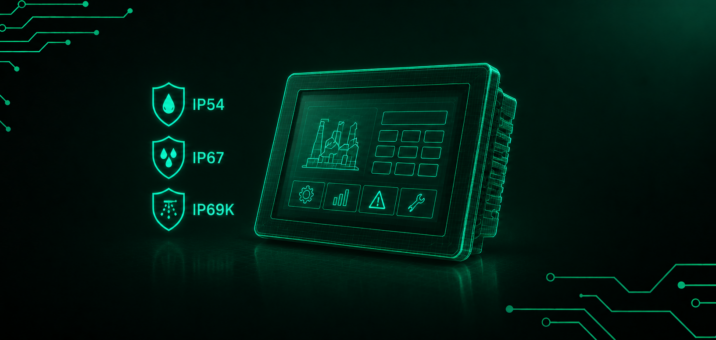
A control panel in a food-processing facility operates in an environment exposed to moisture, grease, and aggressive chemicals. A membrane keypad with integrated printed resistors is sealed, resistant to disinfection, and does not require soldered connections that can corrode within months under such conditions. Collaborative robot grippers, meanwhile, require an “electronic skin” – pressure sensors distributed across a curved surface. Printed resistive traces make it possible to measure gripping force without having to install hundreds of discrete sensors.
The parameters that determine suitability
In a catalogue, every resistive paste can look similar. The differences become apparent after a year of operation in harsh conditions or after the first voltage transient exceeds the design tolerance. Four parameters determine whether a printed resistor will perform reliably in a given application:
- Resistance tolerance – standard screen printing typically results in deviations of around ±20%. Applications requiring higher precision use laser trimming, in which the resistive layer is selectively cut with a laser to precisely adjust its resistance. In thick-film technology, this can reduce tolerance to around ±0.1%; in thin-film technology, it can reach below ±0.01%. Every additional percentage point of precision increases the cost.
- Temperature coefficient of resistance (TCR) – indicates how much the resistance changes as a result of temperature variations. It is expressed in ppm/°C (parts per million per degree Celsius): the lower the value, the more stable the component is across temperature changes. Thick films typically achieve TCR values of around 100–250 ppm/°C, while thin films can reach 5–25 ppm/°C. Where a device operates across a wide temperature range, this parameter can determine the stability of the entire circuit.
- Resistance to moisture and chemicals – thick-film layers, additionally protected with a protective glass coating, withstand exposure to water, grease, and disinfectants well. In outdoor and food-service applications, this can be an essential requirement.
- Pulse resistance – the ability to absorb short-duration voltage surges. Thick-film resistors generally handle pulses better than thin-film resistors because their greater volume allows energy to be distributed rather than concentrated.
Each of these parameters has a direct engineering impact. And each is determined during the selection of the paste and the geometry of the resistive layer – not when ordering off-the-shelf components.
The limits of the technology – when discrete components still win
Printed resistors offer advantages in many applications, but not all. Precision without laser trimming, for example, remains a limitation. A tolerance of around ±20% after printing alone makes the technology unsuitable for precision measurement circuits. Trimming can correct this, but it adds a production step and increases the unit cost.
Power dissipation is also limited by the substrate thickness and the surface area of the resistor. When significant heat is generated in a confined space, a discrete component mounted on a heatsink is the safer solution.
Electrical noise in analogue applications, such as precision sensors and audio transducers, can favour discrete thin-film resistors with a homogeneous metallic-alloy structure. The composite structure of a printed resistor can result in higher current noise.
The choice between printed and discrete technology is therefore not about identifying which one is “better”. It is about matching the technology to the conditions in which the device will operate – one year from now, five years from now, and after a million cycles.
A market growing faster than it appears
The global printed electronics market, valued at more than USD 15 billion in 2023, is forecast to reach USD 45.5 billion by 2031, with an annual growth rate of around 15%. Behind these figures is not a revolution, but an evolution: successive market segments are moving from discrete assembly toward layer-based solutions wherever this makes both engineering and economic sense.
IME (In-Mold Electronics) makes it possible to integrate resistors, sensors, and lighting directly into plastic components such as household appliance housings or automotive cockpits. Multilayer printing shortens the assembly chain. Embedding – integrating passive components within the layers of a circuit board – frees up surface area for active components. Printed resistors occupy the areas where conventional construction creates more problems than benefits.
How does this work in practice at QWERTY?
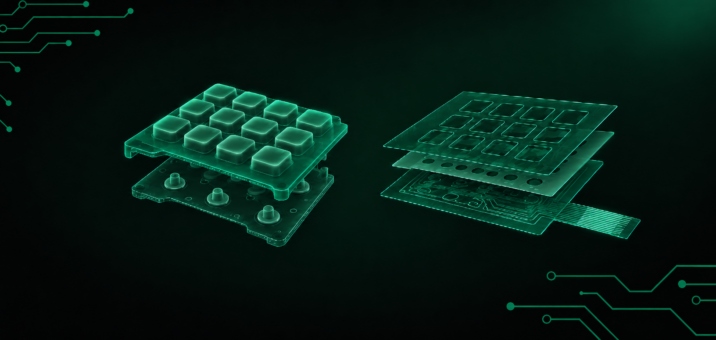
At Qwerty, we treat printed resistors as part of the product design rather than as a separate technological process. Every membrane keypad we design can incorporate resistive layers serving specific functions:
- pull-up and pull-down resistors in the keypad’s digital circuits,
- voltage dividers in control circuits,
- resistive traces for detecting operator pressure – FSR (Force Sensing Resistor) sensors,
- control elements for electroluminescent (EL) backlighting.
The selection of the paste, layer geometry, and printing method is an engineering decision made during the design stage – not a purchasing decision made when ordering components. Every product undergoes actuation-force and durability testing before it reaches the customer.
From our perspective, the difference between a manufacturer that assembles ready-made components and one that designs resistive layers from the ground up only becomes apparent after several years of operation – in failure and warranty statistics.
The sensor in the car seat detects the presence of a passenger. The skin patch measures heart rate. The panel on the production floor has been operating for six years without downtime. Each of these devices contains a layer that someone designed, printed, and verified before anyone else knew it was there.
The most important elements of a design are often the ones the user will never see. That is precisely why we prefer to treat their selection as an engineering decision rather than a catalogue decision.