Go back
  March 2 2026
A keyboard in a tactical command system or the control panel of an armored vehicle must operate flawlessly in extreme conditions – from the deserts of the Middle East to the freezing regions of Northern Europe. At QWERTY, we design interfaces for the most demanding applications, and the military sector sets technical challenges at the highest possible level.
In this article, we present which standards and requirements define modern military keyboards and how our technologies meet these needs.
Standard requirements for military interfaces
Military equipment is subject to some of the most rigorous quality standards in the world. The foundation is the MIL-STD (Military Standard) series – a set of requirements defining technical parameters for every component used by armed forces.
MIL-STD-810 defines environmental resistance. Keyboards must operate in temperatures from -40°C to +71°C, withstand thermal shock, intense vibration during transport in combat vehicles, and exposure to direct sunlight. The standard also includes resistance tests for rain, humidity, salt fog, and dust – conditions typical for combat theaters.
MIL-STD-461 concerns electromagnetic compatibility. Military devices operate in dense environments of radio, radar, and electronic warfare systems. Keyboards must not emit electromagnetic interference affecting other systems and must be resistant to electromagnetic pulses, including the effects of electromagnetic weapons.
MIL-STD-1472 defines operator interface ergonomics. It specifies button dimensions, actuation force, spacing between keys, and functional labeling. When designing military keyboards, we must consider that operators may work with tactical gloves, in darkness, or under combat stress.
Meeting these standards requires a comprehensive approach from the design stage. At QWERTY, every interface component – from material selection and mechanical design to electronics – is developed with all three standards in mind simultaneously. This means parallel environmental, electromagnetic, and ergonomic testing to verify full compliance.
Construction resistant to extreme conditions
Real operational environments exceed most industrial application requirements. Combat vehicles generate continuous vibrations exceeding typical industrial machinery parameters. Desert dust penetrates the smallest gaps, and tropical jungle humidity corrodes electronics within weeks.
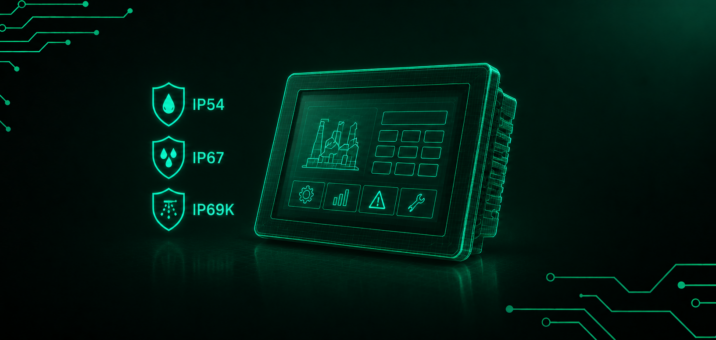
Our military keyboards use reinforced polyester films selected for extreme mechanical loads. We apply special silicone seals providing high IP67 ingress protection – full protection against dust and temporary immersion in water up to one meter. All electronic components are coated with conformal protective layers that guard against moisture, fungi, and corrosion.
We pay particular attention to membrane mechanical durability. We conduct cyclic tests covering hundreds of thousands of actuations per key – far beyond standard industrial requirements. Proper material selection and precision manufacturing ensure durability suitable for years of failure-free operation under intensive use.
EMI/ESD shielding in an electronic battlefield
The modern battlefield is saturated with electromagnetic signals. Radars, communication systems, electronic reconnaissance equipment, and onboard systems create dense frequency spectra in which every device must operate without interference.
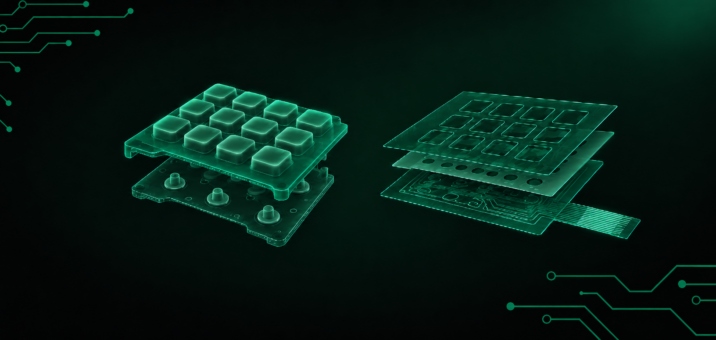
At QWERTY, we implement EMI/ESD shielding technology to protect interfaces against electromagnetic interference and electrostatic discharge. We use multilayer structures with conductive foils and specialized conductive materials developed in our laboratory. These solutions ensure stable electronics operation even in high-interference environments.
Electrostatic discharge protection is especially important in low-humidity conditions, where an operator may unintentionally damage electronics through static discharge from the body. Our keyboards are designed to safely dissipate such charges, protecting sensitive components.
Visibility in all lighting conditions
Operators of weapon or navigation systems work in radically different lighting conditions – from blinding desert sunlight to complete night darkness. Standard lighting solutions fail in such environments.
When designing markings for military keyboards, we use multilayer printing technology with high-contrast pigments. For night applications, we integrate electroluminescent or LED backlighting with adjustable intensity and wavelength compatible with night-vision goggles. Green light with a wavelength of 525 nm does not disrupt dark adaptation and remains invisible to enemy observation devices.
We test legibility in simulated conditions – from direct sunlight (over 100,000 lux) to illumination levels comparable to starlight (below 0.01 lux). Inks and films must retain optical properties after thousands of hours of intense UV exposure.
Ergonomics for operators in tactical gear
Designing user interfaces for military use imposes special ergonomic requirements. Operators may wear thick tactical gloves, which necessitates adjusting button size and actuation force.
We design keys with sufficient surface area and a distinct raised profile for tactile identification. Key spacing minimizes the risk of accidental presses. Actuation force is calibrated to prevent false triggers while avoiding operator fatigue during prolonged use.
Special attention is given to a clearly perceptible tactile feedback at actuation. In high-noise environments, operators must feel that a key has been pressed. We achieve this through precise membrane profiling and multilayer structures with controlled deformation characteristics.
Documentation and compliance with military procedures
Supplying equipment to armed forces requires complete technical documentation compliant with NATO STANAG standards. Each component must have documented material origin, certificates of environmental compliance, and detailed test reports.
Our R&D laboratory maintains full production process documentation – from material batch verification through process parameters to final quality inspection. Each keyboard receives a unique serial number enabling full traceability in identification systems.
Working with military system integrators, we provide full technical support, including maintenance instructions, diagnostic procedures, and spare parts specifications. This documentation is essential for military technical services responsible for operational readiness.
QWERTY – a partner for the defense sector
Our technical infrastructure – from an advanced R&D laboratory to precision production lines – enables us to meet the most stringent military requirements.
We understand that in military applications there is no room for compromise. A keyboard failure at a critical moment can have consequences far beyond ordinary downtime costs. That is why every product undergoes multi-stage quality control and validation testing.
If you are looking for a partner to develop an interface for military equipment that meets the highest standards of reliability and durability – contact QWERTY.