Go back
  July 14 2026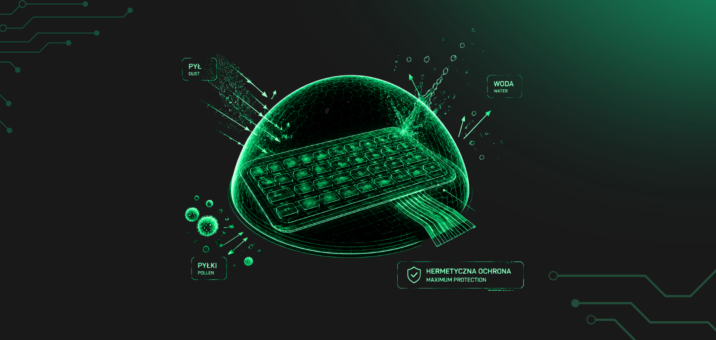
An industrial keyboard working on a production floor has to withstand far more than an accidental coffee spill. Dust, moisture, chemicals, oils – these are the standard conditions in which interfaces controlling machinery or medical devices operate. That’s precisely why sealing has stopped being an optional extra and become a fundamental requirement for professional solutions.
In this article, we’ll look at the available keyboard sealing technologies and the practical benefits that effective protection against external factors brings.
What is keyboard sealing?
Sealing is the process of protecting electronics against the penetration of unwanted substances – from dust and water, through chemical vapors, to fine solid particles. In the case of industrial keyboards, it’s about creating a barrier that protects sensitive electronic components without limiting the device’s functionality.
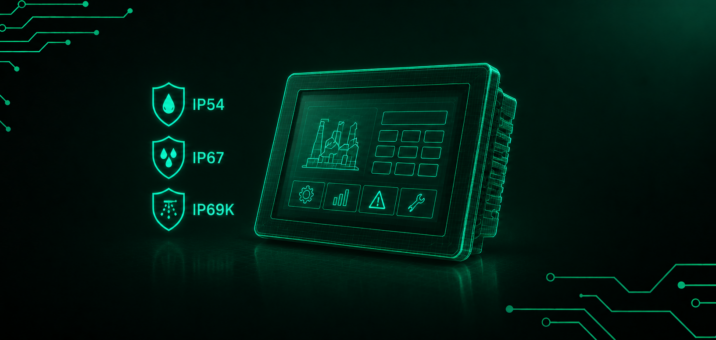
The effectiveness of sealing is defined by the IP (Ingress Protection) standard, which precisely specifies the level of protection. The first digit indicates protection against solid objects (from 0 to 6), the second – against liquids (from 0 to 9). A keyboard rated IP65 is fully dust-tight and can withstand direct jets of water – a parameter frequently found in industrial environments.
Basic sealing technologies
An industrial keyboard working on a production floor has to withstand far more than an accidental coffee spill. Dust, moisture, chemicals, oils – these are the standard conditions in which interfaces controlling machinery or medical devices operate. That’s precisely why sealing has stopped being an optional extra and become a fundamental requirement for professional solutions.
In this article, we’ll look at the available keyboard sealing technologies and the practical benefits that effective protection against external factors brings.
Foil fronts and membranes
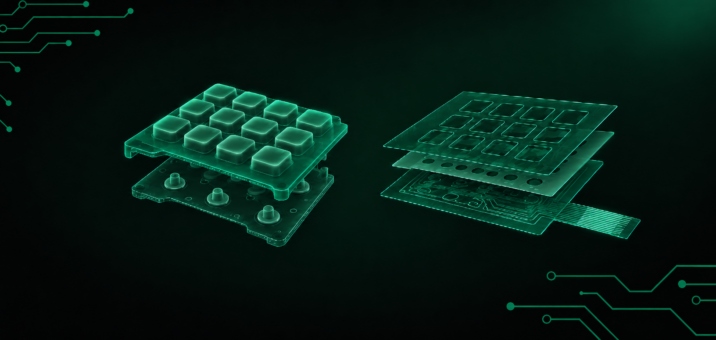
The most commonly used solution is membrane keyboards, in which the entire interface is covered by a continuous layer of polyester or polycarbonate foil. This layer serves a dual role – it’s simultaneously a functional element (responding to pressure) and a protective barrier.
The foils are made from high-strength polymers resistant to abrasion and chemicals. Special coatings, such as a UV layer, further increase durability under extreme conditions – from intense sun exposure to contact with aggressive detergents. Using foil fronts makes it possible to achieve an IP67 protection rating, allowing the keyboard to function even in environments exposed to direct contact with liquids.
Silicone seals
Where full sealing is required while preserving the mechanics of traditional buttons, silicone seals are used. Each key gets an individual elastomer housing that effectively blocks moisture and contaminants from reaching the interior of the enclosure.
Silicone is characterized by excellent resistance to extreme temperatures (from -40°C to +200°C) and retains its elasticity over a long period of time. As a result, the seals don’t lose their properties even after millions of keystroke cycles. This solution works particularly well in applications where the user expects clear mechanical feedback when operating the device.
Resin encapsulation
The most advanced sealing method is encapsulating the entire electronics assembly in specialized epoxy or polyurethane resins. This process creates a monolithic structure that is completely resistant to the penetration of any substances.
Resins are selected depending on the expected operating conditions. For applications in extreme temperatures, compositions with an extended thermal range are used. In environments exposed to vibration, resins with increased flexibility are used, which absorb shocks and protect delicate conductive traces.
The drawback of this method is that repair is impossible – the encapsulated electronics become a single, inseparable whole. That’s why encapsulation is used primarily where absolute reliability outweighs serviceability concerns.
Practical benefits of sealing
Extended lifespan in harsh conditions
An effectively sealed keyboard can operate maintenance-free for years, even in the most demanding environments. A typical non-sealed keyboard in a metalworking plant needs replacing after just a few months – fine metal dust penetrates under the keys, causing short circuits and damage to the conductive traces.
An interface with an IP65 rating or higher eliminates this problem entirely. Protection against dust and moisture means not only a longer lifespan, but also stable, predictable device operation throughout its service life.
Reduced maintenance costs
Sealing radically reduces the frequency of failures and the need to replace devices. In practice, this means less production downtime and lower service costs. A dust-resistant keyboard doesn’t require regular cleaning with compressed air or periodic replacement of keys.
This brings particularly measurable benefits in plants operating continuously, where every unplanned downtime generates measurable financial losses. An investment in a professionally sealed interface pays for itself within the first year of operation.
Safety in sensitive environments
In the food and pharmaceutical industries, sealing is a regulatory requirement, not an option. Devices must withstand aggressive washing with disinfectants and must not pose a potential source of product contamination.
The smooth, continuous surface of foil fronts eliminates places where bacteria could accumulate. At the same time, it allows for effective disinfection without risking damage to the electronics. The same applies in medicine – interfaces on diagnostic equipment or surgical devices must withstand repeated sterilization, which would be impossible without proper sealing.
Choosing the right technology for the application
The choice of sealing method depends on the specific operating conditions and functional requirements. For standard industrial applications, foil fronts providing IP65 protection are sufficient. This is a proven, cost-effective solution that works excellently in most production environments.
Applications exposed to direct contact with liquids or requiring operation underwater need a higher level of protection – IP67 or IP68. This is achieved through additional silicone seals or comprehensive resin encapsulation.
In mobile devices, where weight and interface thickness matter, thin membranes are preferred. Meanwhile, thicker, multi-layer constructions with additional mechanical reinforcements work well in operator panels for heavy industry.
The future of sealing technology
The development of modern materials is opening up new possibilities in sealing. Advanced polymer compositions combine mechanical, chemical, and optical properties, allowing for even better protection while maintaining excellent operating ergonomics.
At the same time, hydrophilic and oleophobic nanocoating technology is developing, capable of repelling water and grease at the molecular level. Although currently used mainly in consumer devices, it is gradually finding its way into professional industrial interfaces as well.
Keyboard sealing is a field where technology translates directly into practical benefits for users. A properly selected sealing method means reliable operation in the most demanding conditions, lower operating costs, and the assurance that the device won’t fail at the least expected moment.