Go back
  September 7 2026
In metallurgy, no one simply says “stainless steel” and expects an engineer to figure out the rest. They talk about “304,” “316,” or “duplex,” because each grade is a different response to a specific operating environment. The category name only tells you that the material is resistant to corrosion; it says nothing about whether the component will survive in a chemical plant, on a ship, or in a bottling line.
The same principle applies to the terminology used for industrial interfaces. “Membrane keypad” and “foil keypad” sound like two distinct types of devices. Distributor catalogues sometimes reinforce this impression by placing them in separate categories. In reality, both terms describe a multilayer construction made from flexible plastic films. The differences that actually affect durability, usability, and resistance lie deeper.
For an engineer or an OEM purchaser (an original equipment manufacturer integrating ready-made components into its own equipment), confusing a naming convention with a genuine technical difference has tangible consequences. You may overpay for a variant that offers no real advantage. Or, worse, end up with a specification that does not match the actual operating conditions.
Membrane keypad construction – the layers that determine functionality
A membrane keypad operates by mechanically closing conductive tracks. The user presses the surface with a finger, causing the upper film layer to flex, pass through an opening in the spacer layer, and make contact with the lower contact area. The circuit closes. The controller registers the signal.
The principle is simple, but that does not mean the construction is simple.
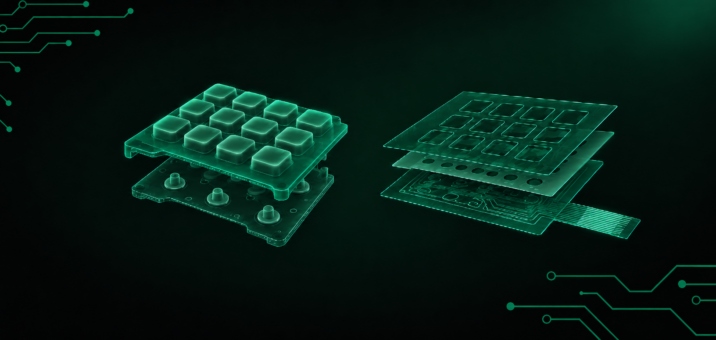
A standard membrane keypad consists of three to six precisely laminated layers. Each serves a specific function:
- Graphic overlay – the outer, visible layer with printed symbols. The graphics are printed on the underside of a transparent film, preventing the print from wearing away during use.
- Spacer – an insulating layer with openings at the button locations. It keeps the circuits separated when the keypad is at rest.
- Circuit layers – films with printed electrical tracks and contact areas, created using conductive inks based on silver flakes or carbon.
- Tactile elements (optional) – metal domes or embossed features in the film that provide a perceptible “click” under the finger. In the industry, this is referred to as tactile feedback: mechanical confirmation that the button has been activated.
- Adhesive layer – enables permanent attachment of the keypad to the device enclosure.
The base material is most commonly polyester, identified as PET. It is the same polymer used to manufacture beverage bottles, but in the form of a thin, durable film. Polycarbonate (PC) is used less frequently, particularly where optical transparency or impact resistance is important.
The circuits and graphics are applied using screen printing or digital printing. The latter allows for customization, including unique serial numbers, QR codes, and gradients.
The result is a structure up to two millimetres thick that combines control, information, and protective functions.
Foil keypad – the same mechanism, a different naming convention
A foil keypad uses the same layers, the same circuit-closing mechanism, and the same materials. The terminology differs because the terms emphasize different aspects of the construction.
“Membrane” emphasizes the operating principle: a flexible membrane deflects under pressure and closes the circuit. “Foil” emphasizes the material: the multilayer construction is based on plastic films.
Both terms therefore describe the same type of device, although distributor catalogues may list them as separate products. From an engineering perspective, the construction is the same: the same layer structure, the same printing technologies, and the same range of materials.
So the question “What is the difference between a membrane keypad and a foil keypad?” has a short answer: none.
A more useful question is: which construction variant within this technology is appropriate for the specific operating conditions?
The name does not create the difference – construction variants do
The important differences between membrane keypads are not defined by “membrane vs. foil.” They follow three main design axes, each of which affects durability, usability, and the range of possible applications.
1. How tactile feedback is achieved
The first axis is the feedback under the operator’s finger – whether the operator can feel and hear the moment the button is activated.
- Flat keypads (non-tactile) have no perceptible travel. The button is simply printed on a smooth film, and activation requires confirmation from an external source, such as an audible signal or an on-screen message. This is the simplest and least expensive construction, but it requires the operator to maintain visual attention.
- Embossed keypads (poly dome) have buttons formed directly in the PET film. The raised shape is embossed into the material itself, without additional components. They provide a soft, quiet “bump” under the finger. They are less expensive than metal-dome versions, but also offer lower durability.
- Metal-dome keypads use small stainless-steel domes placed between the layers. The result is a sharp, clearly defined click and durability measured in millions of cycles. This is a standard solution in medical equipment, heavy industry, and applications where the keypad is operated while wearing protective gloves.
2. Circuit substrate
The second axis is the substrate on which the electrical tracks are printed.
- Flexible film (flex) consists of conductive ink applied to flexible polyester. It is the thinnest, lightest, and most formable option.
- Rigid PCB is a rigid glass-epoxy laminate that replaces the lower film layers, creating a conventional printed circuit board. It allows electronic components such as microcontrollers, connectors, and LEDs to be soldered directly to the keypad assembly.
- Cu-Flex uses flexible copper circuits instead of silver-printed tracks, combining the flexibility of film with better conductivity and greater durability of soldered connections.
3. Outer-layer material
The third axis is the choice between polyester (PET) and polycarbonate (PC).
PET dominates in industrial applications because it can withstand more than one million actuations without cracking and offers high resistance to chemicals, including solvents and disinfectants. PC is selected where optical transparency is important, for example around large display windows. However, it has lower chemical resistance and is more prone to cracking under repeated flexing.
These three decisions determine whether a keypad will survive one million or five million cycles.
The operating environment as the starting point for the specification
The construction variant is a response to the conditions in which the keypad will operate for years, continuously and often without servicing.
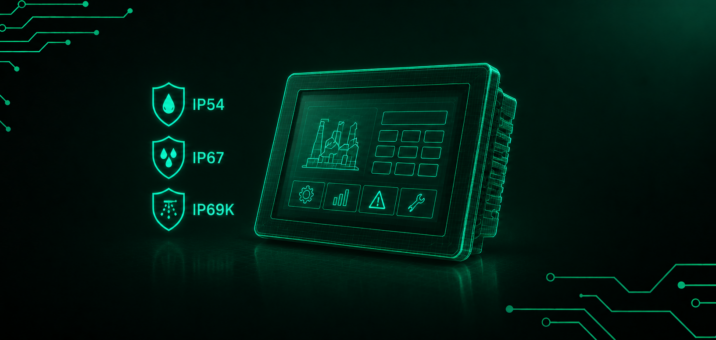
In production halls, CNC machines, outdoor installations, and anywhere exposed to dust, moisture, and vibration, sealing is critical. Membrane keypads can achieve IP65 to IP68 ratings, providing complete protection against dust and, depending on the rating, resistance to water ranging from water jets to continuous immersion. The prerequisite is the appropriate selection of the overlay material and lamination technology.
In medical and food-processing applications, hygiene is the priority. The absence of gaps, a continuous surface, and resistance to disinfectants are normative requirements rather than aesthetic preferences. Some films additionally contain silver nanoparticles with antibacterial properties that inhibit the growth of microorganisms on the panel surface.
Where a keypad is operated while wearing protective gloves, a soft poly dome may not be sufficient. The operator needs clear mechanical confirmation of actuation. A metal dome provides a sharp click and a correspondingly higher actuation force – the resistance that must be overcome with the finger to activate the button.
In portable devices and household appliances, different factors matter: a thin profile and low mass-production cost. Flat or embossed keypads meet both requirements while also providing resistance to splashes.
When a keypad must simultaneously serve as a carrier for advanced electronics – including integrated microcontrollers, USB connectors, or communication interfaces – standard film gives way to a PCB or Cu-Flex substrate.
Variants at a glance
The tables below organize the differences between variants within the same technology.
Comparison of tactile feedback variants
| Variant | Feedback | Durability | Typical application |
|---|---|---|---|
| Flat (non-tactile) | No perceptible travel | Approx. 1 million cycles | Household appliances, LCD display panels |
| Embossed (poly dome) | Soft, quiet “bump” | Approx. 1 million cycles | Consumer electronics, moderately intensive use |
| Metal dome | Sharp, audible click | Up to 5 million cycles | Medical, industrial, glove-operated applications |
Comparison of overlay materials
| Feature | Polyester (PET) | Polycarbonate (PC) |
|---|---|---|
| Flex resistance | More than 1 million actuations without cracking | Lower – may crack under intensive use |
| Chemical resistance | Very high (solvents, disinfectants) | Limited (can become cloudy when exposed to alcohols) |
| Optical transparency | Standard | High – preferred for large display windows |
The table provides a starting point for analysing the operating environment, allowing the range of possible choices to be narrowed before the project enters the detailed specification phase.
How do we approach this at Qwerty?
At Qwerty, we do not offer a “membrane keypad” or “foil keypad” as a standard catalogue product. Every project starts with an analysis of the environment in which the keypad will operate and the requirements imposed by that environment.
The construction variant is selected based on several parameters considered together:
- environmental conditions and the required IP rating,
- type of tactile feedback and required actuation force,
- overlay material – PET or PC, depending on chemical exposure and optical requirements,
- integration with displays, LEDs, electroluminescent (EL) backlighting, or EMI/RFI shielding – layers that protect the electronics against electromagnetic interference,
- certification requirements – from ISO 9001 to AQAP 2110, a quality standard used in projects for the defence sector.
The result is a construction designed for a specific application, tested under conditions similar to the target environment, and manufactured entirely in-house, from printing through to lamination.
This approach requires more time than ordering a standard catalogue panel. It also requires broader expertise from the supplier. From our perspective, however, it is the only approach worth taking for projects intended to operate for many years in demanding conditions.
Let us return to stainless steel. No one orders “stainless steel” for a chemical installation without specifying the exact grade. The category name starts the specification process.
The same applies to membrane keypads. “Membrane” and “foil” are two variants of the same description. The difference between them is purely linguistic.
The difference between a variant selected for the operating environment and one selected simply because it appears in a catalogue is engineering. And it is determined not by the name, but by the cross-section.
That is why we start with the operating environment, not with a catalogue or price list.