Go back
  February 23 2026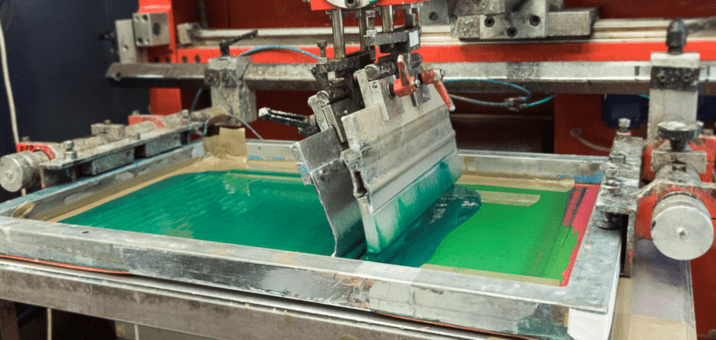
From simple calculators to advanced control panels in factories – membrane keyboards have become the standard in consumer and industrial electronics. Their high quality and durability result from a precise manufacturing process in which screen printing plays a fundamental role.
Screen printing makes it possible to produce accurate prints of conductive paths and protective layers, which directly translates into stable interface performance. At the Qwerty laboratory, we have developed advanced screen-printing techniques tailored to the requirements of modern electronics – from precise application of conductive materials to durable prints designed for intensive use.
In this article, we explain how screen-printing technology supports the production of high-quality membrane keyboards by combining manufacturing precision with long-term functionality.
A brief overview of membrane keyboard construction
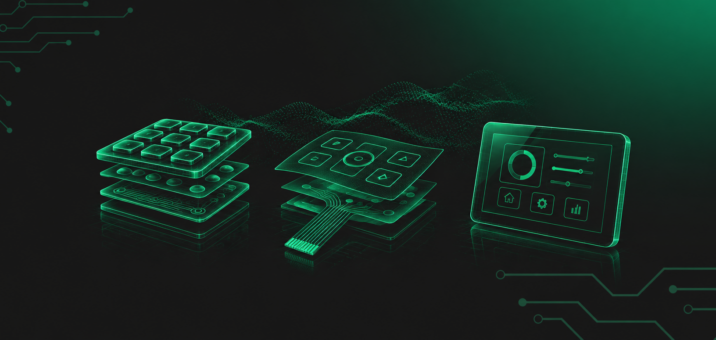
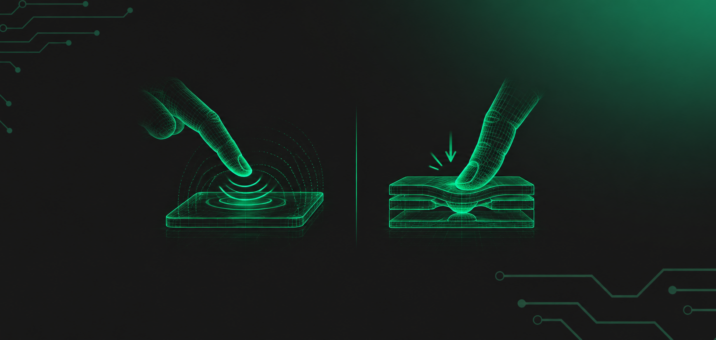
Membrane keyboards are based on a well-thought-out layered structure, where each element performs a specific function. Printed conductive paths placed between foil layers form an electrical circuit that responds to pressure. This solution differs significantly from traditional mechanical keyboards that use physical switches.
The basic structure of a membrane keyboard includes an outer layer with key markings, a precisely designed spacer layer, and a bottom conductive circuit. Depending on the application, additional protective coatings are applied to increase resistance to water and dust. This is where screen printing truly shows its strengths – it allows precise application of both graphic elements and functional conductive paths.
Prints made using screen-printing technology determine the durability of markings and the stability of the electrical parameters of the entire system. Thanks to carefully developed production processes, we achieve repeatable results while maintaining high quality standards.
Screen printing – principle of operation and application in membrane keyboards
Screen-printing technology stands out for its precision and versatility in the production of membrane keyboards. The process involves forcing specialized inks through a mesh with microscopic openings that form the designed pattern on the material surface. This method enables the creation of both functional layers and graphic elements.
In our laboratory, we use screen printing for three main purposes: applying conductive paths that form the keyboard’s electrical circuits, applying protective layers that ensure product durability, and creating precise graphic prints for the user interface. Combining these three functions within one technology ensures production consistency and repeatability of technical parameters.
Conductive electrical paths
Applying conductive paths using screen printing is an advanced technological process that directly affects the performance of membrane keyboards. At Qwerty, we have refined this technology to achieve micrometer-level print precision, ensuring optimal electrical parameters of the final product.
The process uses specialized conductive silver pastes applied to flexible polyester (PET) substrates. After curing, a stable conductive layer is formed that retains its electrical properties even under repeated bending. Advanced thickness-control methods ensure an optimal balance between conductivity and flexibility.
Precision in applying conductive paths is critical. Our laboratory has developed process parameters that maintain appropriate track width and thickness. Tracks that are too wide may cause unwanted electrical connections, while tracks that are too narrow increase electrical resistance.
Insulating and protective layers
Screen printing plays an important role in applying protective layers that secure the electronic components of membrane keyboards. Advanced dielectric inks create an effective barrier against moisture and contaminants while maintaining the flexibility necessary for proper system operation.
The process requires precise control of layer thickness – thick enough to provide protection, yet thin enough not to reduce membrane flexibility or button sensitivity. Modern dielectric inks offer high chemical resistance and excellent mechanical properties.
Particularly important is the protection of layer junctions, where the risk of moisture ingress is highest. Precise screen-printing processes create uniform protective coatings that effectively protect keyboards even in harsh industrial environments.
User interface graphics
Screen printing enables the creation of durable and visually appealing markings on the surface of membrane keyboards. This technology makes it possible to produce precise symbols, labels, and graphic elements that remain legible throughout the entire service life of the device.
The graphic-printing process requires careful selection of inks and printing parameters. The materials used must ensure excellent adhesion and high abrasion resistance. Depending on the intended application, different surface finishes can be achieved – from elegant matte to professional gloss.
Choosing the right graphic printing technique affects not only aesthetics but also usability. Clear, high-contrast markings make it easier to identify individual keys, improving user comfort and work efficiency.
Advantages of using screen printing in membrane keyboard production
In membrane keyboard manufacturing, screen printing stands out as a technology that combines advanced technical capabilities with practical production benefits. This method offers several key advantages:
- High precision – conductive paths and graphic elements can be printed with micrometer accuracy, ensuring stable electrical parameters and consistent quality.
- Production optimization – suitable for both small and large production runs, with fast setup changes and easy automation.
- Durability and long service life – printed elements are resistant to abrasion and environmental factors; conductive paths maintain stable electrical parameters over the product’s lifetime.
- Technological versatility – compatible with a wide range of materials and functional inks, enabling conductive, protective, and decorative layers to be applied within one process.
These advantages make screen printing the dominant technology in membrane keyboard production. Continuous process improvement, combined with modern materials and quality-control systems, meets the growing demands of modern industrial applications.
Screen-printing precision – the foundation of Qwerty keyboards
Screen-printing technology is the foundation of high-quality membrane keyboard production. The precision of conductive-path printing, durability of protective layers, and quality of graphic elements make this method ideally suited to the challenges of modern electronics. Combining proven technology with advanced materials enables the creation of interfaces that meet growing requirements – from simple household devices to advanced industrial systems.
At the Qwerty laboratory, we continuously improve our screen-printing processes to meet our clients’ specific needs. The production techniques we have developed, supported by advanced quality-control systems, allow us to manufacture membrane keyboards that combine high durability with reliable performance. Our expertise in industrial screen printing translates into interfaces that perform reliably even in the most demanding operating conditions.