Go back
  February 23 2026
A strain gauge is a small but extremely precise device that plays an important role in many fields of engineering and science. Its purpose is to measure mechanical deformation, which allows engineers to analyze stresses in materials and structures. Although we rarely think about it in everyday life, strain gauges are widely used in industry, engineering, and scientific research, providing data without which many modern projects would not be possible. In this article, we explain what a strain gauge is, how it works, and how we use it in the production of our industrial keyboards.
What is a strain gauge?
A strain gauge is a sensor that measures changes in the shape of a material caused by external forces such as tension, compression, or bending. The most common type is the resistive strain gauge, which uses changes in electrical resistance in response to deformation. It consists of a thin conductive grid, usually made of metal foil, mounted on a flexible backing. When the material to which the strain gauge is attached deforms, the grid changes its dimensions, which affects the electrical current and allows precise calculations.
The history of strain gauges dates back to the 1930s, when American engineers Edward E. Simmons and Arthur C. Ruge independently developed the first practical versions of these sensors. Their work laid the foundation for a technology that revolutionized mechanical measurements. Today, strain gauges are far more advanced, but the basic principle remains the same – converting physical deformation into a measurable signal.
Advantages and limitations of strain gauges
Strain gauges offer many advantages. They are small, lightweight, and relatively inexpensive, which makes them easy to install even in hard-to-reach places. Their high precision allows the detection of minimal deformations, and the wide range of available models makes it possible to adapt them to almost any task. However, they also have limitations. Sensitivity to temperature and humidity can interfere with measurements if proper compensation is not applied. In addition, installation requires experience – a poorly bonded strain gauge will not perform correctly.
Types of strain gauges
At Qwerty, we use various types of strain gauges, selecting the optimal sensing technology for each specific application. Our R&D lab analyzes the properties of individual solutions to ensure maximum interface performance in demanding industrial environments.
Resistive strain gauges form the basis of most of our industrial solutions. Their proven design ensures stable measurements while keeping production costs reasonable. We use them in standard keyboards exposed to harsh environmental conditions, where long-term parameter stability is essential.
Semiconductor strain gauges are used in interfaces that require exceptional precision. Thanks to their much higher sensitivity to deformation, they can detect even minimal pressure, which is particularly useful in precision machine controllers and medical devices. Our integration method reduces the typical temperature sensitivity associated with these sensors.
In addition, optical strain gauges are used in environments with strong electromagnetic interference, such as production halls with large electric motors or areas with intensive wireless communication. Based on changes in light transmission in optical fibers, they remain immune to electromagnetic fields, ensuring stable keyboard operation even in the immediate vicinity of heavy industrial machinery.
The choice of the appropriate strain gauge type determines the performance parameters of the entire interface. That is why each project is consulted with the client, allowing us to match the sensing technology to the specific industry and operating conditions.
How does a strain gauge actually work?
The operation of a strain gauge is based on a simple yet ingenious principle. In the case of a resistive strain gauge, the key factor is the relationship between deformation and electrical resistance. When the material to which the strain gauge is attached is stretched, the conductive grid becomes longer and thinner, which increases its resistance. Under compression, the opposite happens – the resistance decreases. These changes are recorded by a measurement circuit, most commonly a Wheatstone bridge, which converts them into an electrical signal.
The process requires exceptional precision. The strain gauge must be properly mounted, usually bonded to the surface of the tested object with a special adhesive. Even small errors during installation can affect measurement accuracy. Moreover, the signals generated by strain gauges are very weak, so amplifiers and advanced data processing software are typically used. This makes it possible to measure deformations on the order of micrometers.
Gauge factor
One of the key parameters of a strain gauge is the gauge factor (k), which defines how much the electrical resistance changes relative to the applied strain. For typical metal strain gauges, it is about 2, meaning that resistance changes roughly twice as fast as the deformation. For semiconductor strain gauges, this value can be much higher, increasing sensitivity but also making them more susceptible to temperature changes.
How do we use strain gauges at Qwerty in the production of our keyboards?
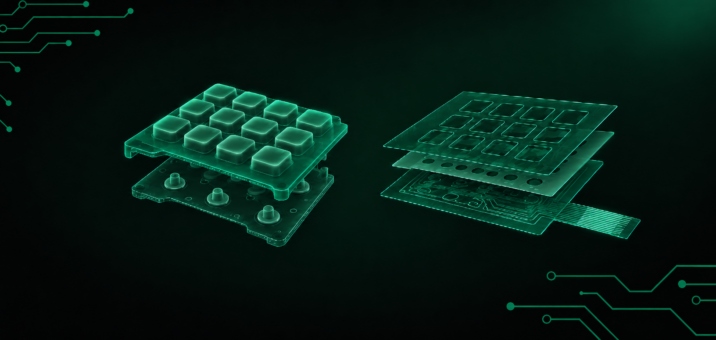
In the design of our membrane keyboards tailored to individual customer needs, strain gauges are an invaluable tool that allows us to precisely meet specific requirements. When we develop a prototype for a particular application – whether it is a control panel for a medical device or an interface for an industrial machine – we mount strain gauges on the foil layers to examine how the material reacts to pressure under defined conditions. For example, if a client needs a keyboard that is highly sensitive to light touch, strain gauge data helps us adjust membrane flexibility by selecting the appropriate foil thickness or material composition, achieving the desired response without sacrificing durability.
Testing these unique designs is another stage where strain gauges prove indispensable. Each client has different expectations – one requires a keyboard resistant to thousands of strong presses per day, while another needs a delicate interface that will not deform due to moisture or temperature changes. By bonding strain gauges at strategic points on the prototype, we simulate real-world usage scenarios and measure deformation with micrometer-level precision. This allows us to predict long-term behavior and introduce improvements – such as reinforcing critical areas or modifying contact layouts – before delivering the final product.
Our approach is based on close cooperation with the client, and strain gauges help us turn their vision into reality. Once the design is finalized, we also use them for final verification. We test the finished unit under the specific loads defined by the client, recording how the membrane responds to pressure at key points. When the results meet or exceed expectations, we know we are delivering a solution truly tailored to the user’s needs.