Go back
  April 27 2026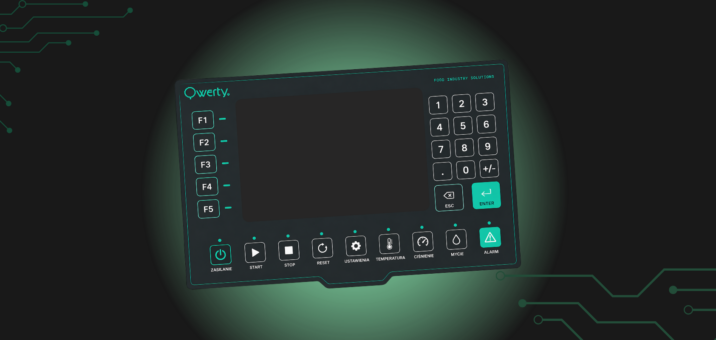
When we talk about the food industry, we are talking about responsibility – for quality, safety, and process repeatability. Every element of the infrastructure, including the operator interface, must carry that responsibility. In this environment, two abbreviations matter: HACCP and IP69K. The first concerns food safety, the second – the resistance of equipment to extreme cleaning. Together, they define a standard that is a real test of competence for HMI interface manufacturers.
HACCP and interface design – designing with contamination risk in mind
The HACCP system is a method of hazard analysis and identification of critical control points in food production. It covers every stage – from raw material intake to packaging. The goal is to minimize the risk of biological, chemical, and physical contamination.
Within this framework, an industrial keyboard is part of the production environment. If its design promotes contamination buildup, it becomes a potential source of secondary contamination.
The main issues include:
- gaps and hard-to-reach areas
- sharp edges
- porous or absorbent materials
- improperly sealed joints
Moisture and organic residues create ideal conditions for microorganism growth. That is why designing devices for this industry must follow hygienic design principles: smooth surfaces, minimal mechanical joints, and well-designed sealing systems. This is not about aesthetics – it is about risk management.
IP69K in industrial practice – sealing under high-pressure cleaning
Cleaning in food processing plants is not gentle wiping. It is an intensive process involving high-pressure water at elevated temperatures, often combined with aggressive chemicals.
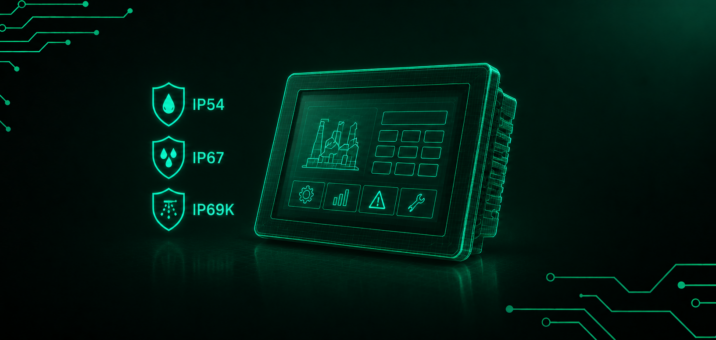
The IP69K protection class means resistance to water ingress during high-pressure, high-temperature cleaning (up to around 80°C). The test includes spraying from multiple angles to simulate real cleaning conditions.
It is important to distinguish between IP67 and IP69K. IP67 refers to temporary immersion in water. IP69K refers to dynamic, aggressive cleaning. These are entirely different operating scenarios.
To function under such conditions, a device must ensure:
- materials resistant to temperature and chemicals
- long-term durability of sealing elements
- stable electrical performance despite frequent temperature changes
In practice, IP69K is not a single parameter, but the result of a coherent design approach.
Materials and geometry – the two pillars of hygienic design
In the food industry, material selection is not neutral. It directly affects durability and hygiene. Stainless steel with high corrosion resistance and specialized plastics resistant to detergents and disinfectants are commonly used. The term “stainless steel” alone is not sufficient – its grade, processing, and surface finish are critical.
The geometry of the enclosure is equally important. Every recess, poorly designed joint, or micro-gap can accumulate moisture and product residues. Therefore, the design should allow free water drainage and effective cleaning without disassembly.
Surface texture also plays a key role. Too rough encourages contamination buildup; too smooth may reduce usability when wearing protective gloves. Designing keyboards for the food industry is a constant balance between hygiene and ergonomics – one that must work in real production conditions, not just in documentation.
Interface under pressure – ergonomics in a production environment
On the production floor, speed and repeatability matter. Operators work in noise, varying temperatures, and under pressure to maintain process continuity. The interface must not require interpretation – it must be unambiguous.
Label clarity, tactile feedback, and print durability are not stylistic details but elements that directly affect process safety. If a button does not respond precisely or markings fade after months of cleaning, the risk of error increases. And an error in parameter settings can mean downtime or product recall.
A well-designed interface behaves predictably. It supports the process rather than distracting from it. In industrial environments, technology must be stable and intuitive – the operator should not wonder whether a button will work, but focus on the process itself.
Design expertise in a demanding environment
Designing industrial keyboards for the food industry requires combining knowledge of mechanics, materials science, and electronics. HACCP standards and IP69K classification are starting points, not solutions in themselves. The key lies in translating them into a coherent design.
At Qwerty, we continuously develop our expertise in HMI interfaces for demanding industrial environments. Such projects require analysis of operating conditions, risk assessment, and consideration of long product life cycles. It is not just about passing a single test, but about maintaining stable parameters over years of intensive use.
In the food industry, every audit and quality inspection can verify adopted solutions. That is why the design must be treated as a complete system – from housing and sealing to the user layer and system integration.
Qwerty and the role of interfaces in food production safety
A keyboard is not the most visible element of a production line. It does not attract attention like dosing systems or packaging robots. Yet it is through this interface that operators confirm process parameters, respond to alarms, and initiate subsequent production stages.
If it fails, the consequences are immediate and measurable.
HACCP and IP69K are not marketing terms. They are concrete requirements that directly influence device design and engineering. In an environment where food safety is critical, even the smallest interface becomes part of a system of responsibility.
Where responsibility is this real, expertise must be built on design experience, precision in execution, and a consistent approach to the entire product lifecycle. And it is precisely here that true expertise in interface manufacturing is defined.