Go back
  March 23 2026
 A membrane keypad may look simple…
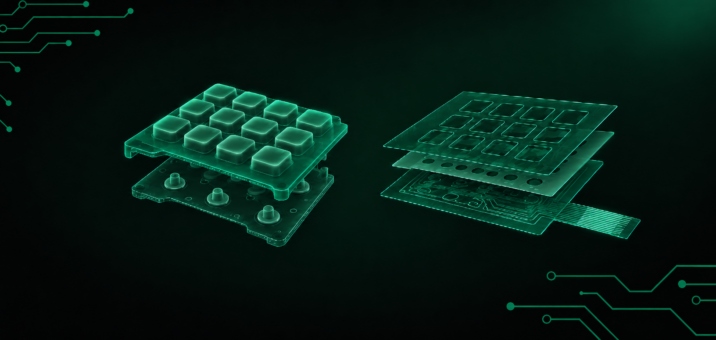
A membrane keypad may seem inconspicuous. A thin layer of material with printed graphics, beneath it conductive traces and contact domes. Yet it is a structure where every micrometer of material matters. In technical specifications, abbreviations such as PET, PVC, and TPU often appear. For some, these are just material names. For an engineer, they represent specific parameters, limitations, and design risks.
The differences between these materials are not just about cost. They determine print durability, resistance to chemicals, user comfort, and the lifespan of the entire panel. That is why the choice of film is not a minor detail, but one of the foundations of overall product quality.
A layer that does more than it seems
The outer film in a membrane keypad performs several functions at once. It protects the electronics from moisture and dust, transfers the force of pressing to the contact elements, protects the printed graphics, and determines the tactile feel.
It must be thin, yet resistant to material fatigue. Flexible, yet dimensionally stable. Aesthetic, yet capable of withstanding thousands of actuations.
In practice, this means a balance between elasticity, hardness, chemical resistance, and thermal stability. This is where the differences between PET, PVC, and TPU become significant.
PET – precision and stability under control
PET, or polyethylene terephthalate, is valued in electronics primarily for its stability. In membrane keypads, this means one thing: minimal deformation even under significant changes in temperature and humidity.
Why is this so important? Because beneath the decorative layer are precise conductive traces. Any uncontrolled material behavior can lead to microcracks or loss of electrical contact. PET maintains layer geometry, which translates into consistent performance.
Additionally, this material works well with screen printing and conductive inks. It ensures high-quality graphics, sharp edges of symbols, and good print durability.
From the user’s perspective, PET feels relatively rigid. It provides a more defined tactile response and a more “technical” feel. For this reason, it is commonly used in machine control panels, medical equipment, and industrial systems, where precision and repeatability are critical.
PVC – flexibility and cost compromise
PVC, or polyvinyl chloride, has long been one of the most commonly used materials in simpler control panels. Its popularity comes from good flexibility and a favorable price.
PVC is easy to process, accepts printing well, and allows for various visual effects – from matte to glossy finishes. It feels softer than PET, which can improve comfort in less demanding applications.
However, it must be said clearly: PVC has limited resistance to high temperatures and aggressive chemicals. In environments where panels are regularly cleaned with strong detergents or exposed to temperature fluctuations, it may degrade faster.
In projects with moderate usage intensity and controlled environments, PVC can be a rational choice. In more demanding industrial applications, it is increasingly being replaced by more stable materials.
TPU – resistance in harsh environments
TPU, or thermoplastic polyurethane, is a material with distinctly different properties. It combines high flexibility with excellent resistance to abrasion, oils, greases, and many chemicals.
In practice, this means greater durability in industrial, workshop, or laboratory environments. TPU performs well under intensive use and in contact with substances that would be problematic for other films.
Its characteristic feature is a softer, more “rubbery” feel. This is especially useful where operators wear gloves or where long-term comfort is important.
On the other hand, TPU is more expensive and more demanding in processing. It requires precise control of production parameters, which increases process complexity. In return, it offers superior mechanical and chemical resistance.
Material choice is a design decision
Selecting the film should not begin with the question “what is cheaper?”, but with an analysis of the operating conditions. In practice, several key factors are considered:
- operating environment – moisture, UV radiation, detergents, oils
- usage intensity – number of actuations over the product lifecycle
- aesthetic requirements – transparency, backlighting, scratch resistance
- budget and technological constraints
Each of these factors influences the final material choice. A poorly selected film may perform well in laboratory tests but fail after a few months in real-world conditions.
At Qwerty, expertise starts with details
In membrane keypad design, there is no room for randomness. Choosing between PET, PVC, and TPU is not a matter of preference, but a response to specific technical requirements.
Each of these materials has different tensile strength, abrasion resistance, temperature response, and UV resistance. These are not theoretical values from a datasheet – they translate directly into real performance after thousands of actuations.
The differences become especially visible over time. A material with lower dimensional stability may slightly deform. This is enough to change actuation force or cause microcracks in conductive layers. The user will only notice this when the keypad starts responding inconsistently.
Compatibility with production technology is also critical. Not every film works equally well with conductive inks, lamination, or embossing. Mistakes at this stage can lead to delamination, loss of print adhesion, or reduced sealing performance.
Understanding the properties of PET, PVC, and TPU allows us to treat the keypad as a system of layers that must function as a whole.
Quality is not defined by appearance or initial tactile impression. It is defined by whether the product maintains consistent performance over years of use.
This is where reliability is decided – at the level invisible to the user. This is where material science meets engineering practice: data analysis, lifecycle testing, and environmental validation.
In industries where a keypad is a critical interface for machines or medical systems, this approach is not optional. It is the standard.