Go back
  July 15 2026
 End of shift at a packaging plant. The cleaning crew comes in with a pressure washer. Two control panels sit on the line – both flat, touch-operated, both labeled with the same “START.” One will come out of this procedure without a mark on it. The other might not.
You can’t tell the difference with the naked eye, and the catalog specs read about the same. Yet after a year in the same environment, the service history of these two devices will look completely different – one heads to the service department within a few months, the other runs through the machine’s entire service life without a single intervention.
Two technologies, two design logics
Membrane and glass solve the same problem – giving the operator a tool to control the machine – but they start from different construction principles.
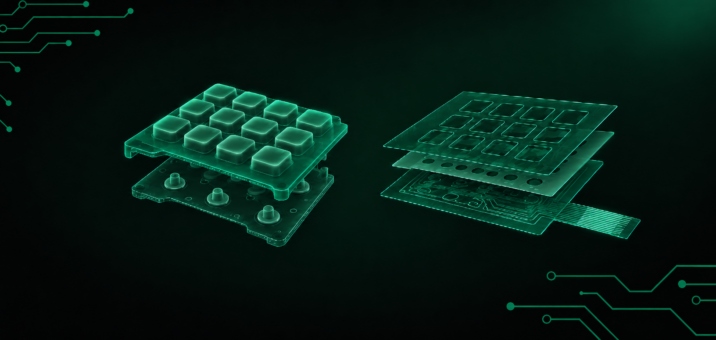
A membrane keyboard is a multilayer foil construction. The operator presses the surface, the layers make contact, the circuit closes. Versions with so-called tactile feedback – a perceptible “click” under the finger – have built-in metal domes that provide physical confirmation of the press. Actuation force, travel, resistance – every parameter is designed so the hand feels the moment of activation. A membrane is, by design, a mechanical construction, even though at first glance it looks like a smooth sticker.
A glass panel works differently. A monolithic pane, with a capacitive or force sensor underneath. No moving parts, no layers to short against each other. In the capacitive version, a finger just needs to approach the surface; in the force-sensing version, pressure is needed – but in both cases, without any mechanical movement. The whole assembly sits behind a rigid, uniform surface that by its very nature has no gaps or foil seams.
Operating conditions as the deciding factor
On a spec sheet, both solutions look comparable, but a year of operation in a specific environment reveals the difference. Glass panels have the advantage anywhere the environment demands parameters a foil membrane can’t sustain over the long term. Temperatures above 70–75°C – roughly the upper working limit for most membranes – is the first such threshold. Aluminosilicate glass, a variant with enhanced thermal and chemical resistance, works stably up to 150°C.
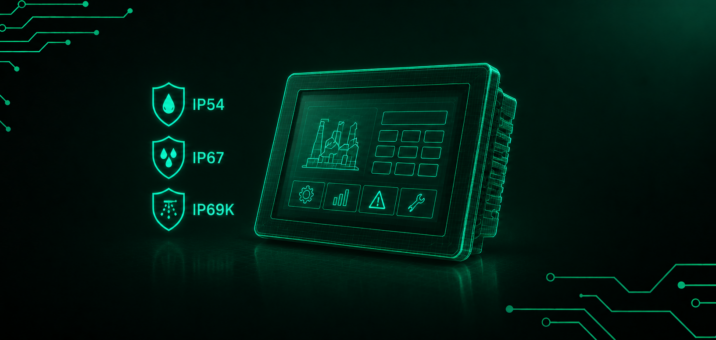
The second threshold is pressure disinfection. The IP69K rating, meaning resistance to a water jet at 80–100 bar and 80°C, is standard in the food and pharmaceutical industries. Glass panels mounted in stainless steel housings meet this requirement. Membranes, whose layers can delaminate under such aggressive washing, typically top out at IP65 or IP66.
The third is UV exposure. Polycarbonate foils yellow and lose transparency under sunlight. Glass retains its optical stability for years, with no need for additional protective coatings.
The fourth is the requirement for a gap-free surface. Wherever hygiene standards call for eliminating micro-irregularities where microorganisms could accumulate, a single glass pane meets those expectations by design alone. It requires no design compromises and no additional safeguards.
Where membrane still wins
In many industrial applications, membrane remains the more sensible, cheaper choice. For instance, when an operator wearing thick protective gloves needs feedback, a physical “click” – a perceptible travel of the button – lets them work without constantly looking at the panel. On a noisy production floor, where an audible signal gets lost in the background, a tactile confirmation of the press can be the only reliable feedback channel, because without it the operator has to verify every command visually, which slows the work down and increases the risk of mistakes.
Membranes work on the principle of mechanical pressure. The type of glove – thick, thin, rubber, leather – has no effect on whether the signal registers. A standard capacitive glass panel, on the other hand, responds to a change in an electric field, which means a thick insulating material can effectively “blind” it. Solutions exist that eliminate this problem – force sensors, front-deflection detection technologies – but they raise the cost and complexity of the design.
Then there’s the economics. In high-volume runs and standard operating conditions – no extreme temperatures, no aggressive disinfection – membrane offers a lower unit cost and sufficient durability.
Durability starts where the spec sheet ends
A hundred million cycles for a glass panel. One to five million for a membrane with a click. The gap looks unambiguous at first glance, but in practice, comparing the durability of these two technologies one to one is difficult.
The most common cause of membrane degradation turns out to be cleaning mistakes – using a pressure washer, an aggressive solvent, or abrasive scrubbing that wears away the graphic layer. Another is dirt and moisture working their way under the surface, which over time causes short circuits along the conductive traces. A membrane rated for a million cycles can degrade within a few months, and the wrong cleaning agent is all it takes.
With glass, failures look different. A capacitive sensor can “freeze up” from water pooling on the surface. Graphics printed on the outer face degrade under UV exposure. These limitations have known engineering solutions – ceramic printing, optical bonding (permanently fusing the layers together with adhesive across the entire surface), moisture-resistant sensors – but they require a deliberate choice of technology at the design stage.
Purchase cost versus cost of ownership
A glass panel costs more upfront, but the full cost of ownership – known in the industry by the acronym TCO, for Total Cost of Ownership – covers not just the purchase price but the total spent on service, downtime, and replacement across the device’s entire service life. Only at that level of accounting does it become clear which technology actually costs less.
On a membrane, the graphics printed on the outer foil layer wear away with intensive use. Restoring a foil front can cost more than half the price of a new keyboard. On glass, the print sits on the underside of the pane – mechanical access to it is physically impossible. The graphics last as long as the glass itself does.
A membrane that needs replacing every few years in an aggressive environment generates service costs that gradually outweigh a one-time investment in glass. A single unplanned production line stoppage caused by an interface failure can cost more than the entire price difference between the two solutions. On the other hand, where the interface operates under mild conditions and doesn’t require frequent disinfection, a membrane holds up for years, and its lower purchase cost remains a genuine saving.
How this looks at Qwerty
At Qwerty, before choosing a specific technology – glass, membrane, or a hybrid solution – we analyze the conditions the interface will operate in:
- the temperature range and exposure to weather conditions,
- hygiene requirements and disinfection frequency,
- the type of operator and how the device is handled – gloves, bare hands, thin nitrile gloves,
- the machine’s expected service life and the allowable service budget,
- the complexity of the visualization and the need for multi-touch operation.
Only then do we select a solution. Sometimes it’s glass. Sometimes it’s membrane. Sometimes it’s both in a single device, because in practice some functions call for a perceptible click, while others call for a smooth, sealed surface. From our perspective, the right interface is one that, after three years of operating in a specific environment, doesn’t need any explanation for why it has to be replaced.
Choosing an interface means choosing a trade-off
The two panels on the packaging floor that looked identical at the start of this piece have very different stories a year later. One needs its graphics restored and its seals inspected. The other just needs a wipe with a cloth. The difference came down to how well each was matched to the environment it operated in – not because one panel was “better” than the other.
A decision that looks purely technical actually determines costs, production continuity, and operator safety. That’s exactly why it shouldn’t be made from a catalog alone.