Go back
  February 27 2026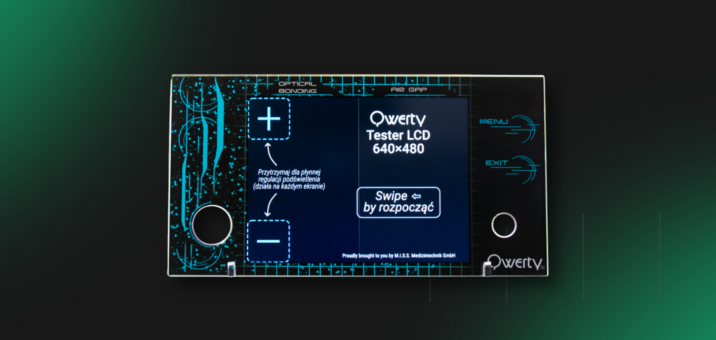
Modern production lines are dense networks of electronic devices that must operate together without interfering with one another. A single improperly shielded interface can paralyze an entire production hall, causing losses reaching hundreds of thousands of zlotys. In this context, electromagnetic compatibility is no longer a technical curiosity, but the foundation of reliable industrial automation.
At Qwerty, we have been designing industrial keyboards resistant to electromagnetic interference for years. Our hands-on experience delivering projects across industries – from medical to automotive – confirms that proper EMC management is not just about using the right materials, but above all about a comprehensive approach to designing the entire control system.
What is electromagnetic compatibility?
Electromagnetic compatibility (EMC) is the ability of an electronic device to operate correctly in an environment full of electromagnetic interference while not generating unwanted emissions that could disturb other devices.
In practice, this means that a control interface must meet two fundamental requirements. First, it must be immune to external interference – from electric motors to welding equipment and radio systems. Second, it must not generate electromagnetic emissions that exceed permissible limits.
The problem becomes particularly important in modern production plants, where dozens of electronic devices operate in a confined space. Motor inverters, welding systems, plasma cutting equipment, or industrial radio modems – all of these generate strong electromagnetic fields. In such an environment, a poorly designed interface may react with random signals, causing unpredictable behavior of the entire production line.
EMC standards and regulations in industry
Designing devices compliant with EMC requirements is based on precisely defined international standards. The foundation is the EN 55000 and EN 61000 series of standards, which define permissible emission levels and immunity requirements.
For industrial equipment, EN 61000-6-2 is particularly important, as it specifies immunity requirements for industrial environments. This standard reflects the specific conditions of production plants, where devices must operate in the presence of strong magnetic fields and high-energy electrical transients.
Equally important are the emission requirements defined in EN 61000-6-4. Industrial devices are allowed to generate higher emissions than household equipment, but they must still remain within strictly defined limits so as not to interfere with telecommunications or radio systems.
From experience, we know that meeting standards is only the minimum – real industrial environments often impose much higher demands. That is why, in designing our keyboards, we apply safety margins that exceed standard normative requirements.
EMI/ESD shielding as the foundation of compatibility
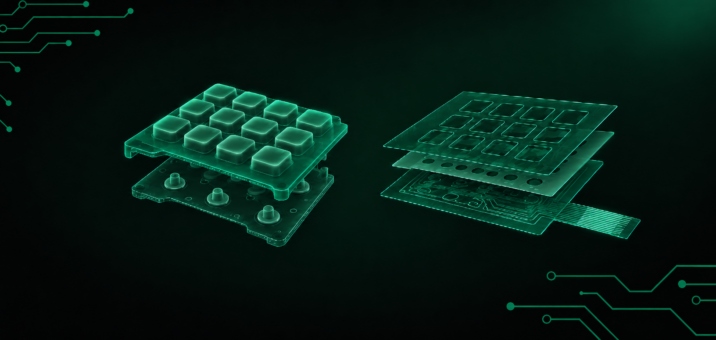
Effective electromagnetic shielding in industrial keyboards is based on creating a continuous conductive layer that acts like a Faraday cage around sensitive electronic components. Such protection effectively blocks both interference coming from outside and emissions generated by the interface itself.
In practice, this means using special conductive layers that must maintain electrical continuity over the entire keyboard surface. Even the smallest damage to this layer can create “windows” through which electromagnetic interference can penetrate, drastically reducing the effectiveness of the entire protection system.
Particular attention must be paid to areas susceptible to mechanical damage – edges, button openings, or connectors. In these zones, we use reinforced shielding systems that maintain continuity of protection even under intensive industrial use.
Optical bonding as part of EMC protection
Optical bonding technology, which we use in advanced interfaces, is not only about improving display quality, but also an important part of the EMC strategy. Eliminating air gaps between display layers significantly reduces the formation of resonant cavities that can amplify certain interference frequencies.
The bonding process permanently connects the touch panel to the display using optically transparent conductive adhesives. This creates a monolithic structure with increased mechanical strength and improved electromagnetic properties.
Designing electronics resistant to interference
Effective EMC protection goes far beyond shielding alone. Thoughtful electronic design of the keyboard is equally important – from trace topology to the selection of electronic components.
Minimizing current loops is a fundamental rule of interference-resistant design. Every loop in a circuit acts like an antenna, picking up external interference and converting it into unwanted signals. That is why, in our designs, we use routing techniques that minimize connection lengths and eliminate unnecessary loops.
Equally important is the proper placement of decoupling capacitors and ferrite beads. These seemingly small components can determine the immunity of the entire device to high-frequency interference. Our practice shows that 100 nF ceramic capacitors placed directly at the power pins of each integrated circuit effectively suppress interference in the 10 MHz to 1 GHz range.
Electromagnetic compatibility with Qwerty keyboards
Electromagnetic compatibility in control devices is an investment in the reliability and predictability of the entire production system. Our experience in delivering solutions for demanding industries shows that addressing EMC properly at the design stage helps avoid costly problems later and ensures stable industrial automation over years of operation.
At Qwerty, we combine theoretical knowledge with a practical, hands-on approach to solving EMC challenges. Our industrial keyboards not only meet the required standards but often exceed them, providing customers with an additional safety margin in the most demanding applications. This approach allows us to build long-term partnerships with leaders across multiple industrial sectors.