Go back
  February 27 2026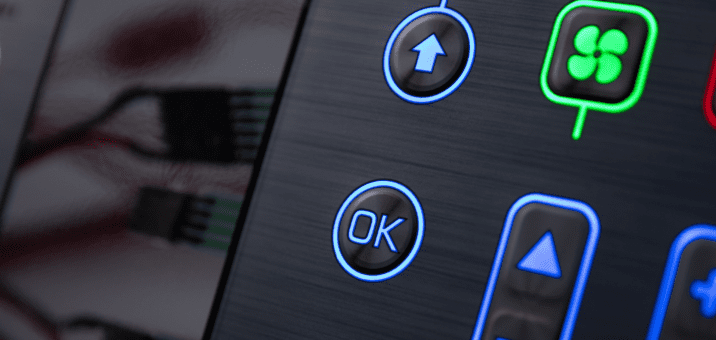
Embossing in industrial user interfaces – tactile feedback that really matters
In modern industrial user interfaces, touch plays a crucial role. An operator working in protective gloves or in poor lighting conditions must be sure they have pressed the correct button. This is where embossing techniques transform flat foil surfaces into ergonomic interfaces with clearly tactile buttons.
At QWERTY, we have been refining embossing technologies for years, creating membrane keyboards that combine mechanical precision with durability in harsh industrial environments. Our experience shows that properly designed domes can radically improve safety and operational efficiency.
What is embossing in membrane keyboards?
Embossing is a manufacturing process in which three-dimensional domes are formed on flat polyester or polycarbonate foils to represent the shape of buttons. Using dedicated tooling and controlled pressure, we achieve precisely shaped tactile elements that can be clearly felt by the operator’s fingers.
This technique preserves all the advantages of membrane keyboards – sealing, chemical resistance and easy cleaning – while adding functionality similar to traditional mechanical buttons. The difference is that instead of separate moving parts, the entire interface is a single, integrated surface.
Our laboratory has developed proprietary embossing methods that guarantee long-term shape stability. Even after millions of actuation cycles, the buttons retain their original tactile properties, which is critical for industrial applications requiring maximum reliability.
Embossing technologies
Several advanced embossing techniques can be used in production, depending on the specific project requirements and the chosen materials. Each method has unique properties, and process parameters such as pressure time, temperature and tooling design are optimized for the target industry (e.g. medical, food processing or petrochemical).
Hot embossing
This method uses elevated temperature and pressure to permanently shape the foil. Heated tooling enables sharp, well-defined button edges. Hot embossing is particularly suitable for thicker foils that require greater forming force.
The process ensures exceptional durability of the domes – the formed buttons retain their shape even under extreme temperatures and heavy-duty operation. We use this technology, among others, in keyboards for the petrochemical industry, where interfaces must withstand contact with aggressive substances.
Cold embossing with long dwell time
In this method, forming is carried out at room temperature but with a significantly longer pressing time. Special pneumatic presses maintain constant pressure for several minutes, allowing the material to fully conform to the tooling shape.
Cold embossing is especially suitable for thin polyester foils, where excessive heating could damage the material. This technique also allows for very subtle domes, ideal for applications requiring delicate tactile feedback.
Hybrid forming techniques
Our R&D team has developed proprietary methods combining different embossing techniques within a single process. This makes it possible to design interfaces with varied dome heights and tactile characteristics – for example, primary control buttons can be distinctly raised, while auxiliary buttons remain flat.
Impact of embossing on interface functionality
Well-designed embossing transforms a membrane keyboard from a simple input device into an ergonomic interface that supports intuitive operation. Our studies show how specific dome parameters influence overall usability.
Operational precision and error reduction
Tactile button contours allow operators to position their fingers accurately without looking at the keyboard. This is particularly important in industrial environments, where operators often control machines while visually monitoring the production process.
Our ergonomic tests indicate that embossing can significantly reduce the number of incorrect presses. In practice, this means fewer accidental line stoppages and higher operational efficiency.
Adaptation to harsh working conditions
Embossing is especially valuable in demanding environments. Operators wearing thick protective gloves, working in dusty halls or under poor lighting can rely on touch rather than vision. Properly shaped domes act as tactile guides, directing fingers to the correct positions.
For example, in a keyboard designed for the food industry, different button shapes can be used – a main START button with a distinctive raised dome and central groove, a flat STOP button with a slight recess, and emergency buttons with additional protective rings. Such differentiated topography allows instant function recognition even in stressful situations.
Technical parameters and process optimization
At QWERTY, every embossing project starts with a detailed analysis of operational requirements. Dome parameters – height, curvature radius and wall angle – are tailored to the specific application.
Dome height and profile
Standard domes in our keyboards range from 0.3 to 1.2 mm in height, depending on foil thickness and functional requirements. Lower domes are suitable for applications requiring frequent cleaning, while higher domes provide better tactile identification.
The dome profile – the cross-sectional shape – is equally important. Sharp edges provide clear tactile feedback but may be less comfortable during prolonged use. Smooth transitions are more ergonomic, though they require more precise finger positioning.
Durability and shape stability
Our cyclic testing shows that properly executed embossing maintains shape stability throughout the keyboard’s service life. We use specialized test rigs that simulate millions of actuation cycles in accelerated conditions.
We pay particular attention to high-stress transition zones between flat areas and domes. Here, we apply proprietary material reinforcement techniques that prevent cracking and loss of elasticity.
Embossing technology aligned with real-world needs
Button embossing in membrane keyboards combines precise manufacturing technology with a deep understanding of user needs. At QWERTY, every dome is the result of a deliberate design process that considers all aspects of use – from ergonomics to long-term durability. Our experience confirms that well-executed embossing can significantly improve the functionality and safety of industrial control interfaces. As part of customization, we also offer embossing of logos, tactile symbols and custom markings, allowing the product to be perfectly tailored to customer requirements.