Go back
 October 29 2026
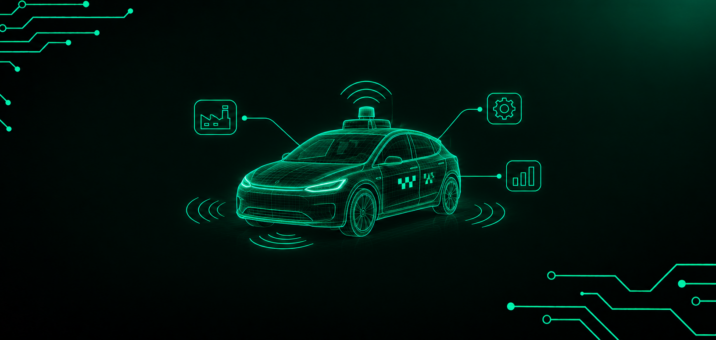
Los Angeles, night, a six-lane highway. There is no one in the driver’s seat. An object lies on the road – a tyre, perhaps a box; at that speed, it is difficult to tell. The vehicle’s system detects the obstacle, calculates a trajectory, activates the turn signal and steers around it. Reaction time: less than ten milliseconds. In those lighting conditions, the human eye would probably not have spotted it in time.
Autonomous taxis in the United States have already travelled tens of millions of miles without a human behind the wheel. LiDAR scanners, radars and cameras operate in parallel, building a three-dimensional picture of their surroundings, measuring distances and recognising road signs. Each sensor detects something the others do not. Together, they generate around ten terabytes of data per hour of driving. The onboard computer processes this data locally, without sending it to a server or waiting for a response.
This article looks at mechanisms that work just as well on a factory floor, in a warehouse or on an assembly line. A highway full of variables – pedestrians, other vehicles, roadworks, rain and unpredictable driver behaviour – is a more challenging environment than the controlled conditions of an industrial facility. If an algorithm can handle that, manufacturing should be an easier test.
A machine sees more than a human
Fatigue, distraction, a phone in hand, excessive speed. Human factors account for 94% of serious road accidents. An algorithm has none of these weaknesses. The Waymo fleet, a subsidiary of Alphabet, Google’s parent company, has travelled more than 22 million miles without a driver. Compared with human drivers travelling on the same roads, it recorded 73% fewer crashes involving injuries and 84% fewer serious incidents in which airbags were deployed. Cruise, a subsidiary of General Motors, recorded 92% fewer at-fault collisions over a distance of one million miles. The statistics from both fleets point in the same direction: machines drive more safely.
On a factory floor, the same problem occurs on a different scale. A quality-control inspector on the night shift looks at the hundredth component and sees less than they did when inspecting the first. Eyes get tired, attention wanders, and the hand reaches for the next part almost automatically. A deep-learning-based vision system – a program that learns to recognise patterns from thousands of training images – analyses the dimensions, shape and finish of every component in a fraction of a second, with the same accuracy at three in the morning as at eight in the morning.
In machining processes – shaping metal through milling, turning or drilling – the use of statistical process control, involving continuous measurement of dimensional deviations and automatic adjustment of process parameters, has helped bring the defect rate down to 0.0%. No defective components across the entire production run. CenterLine has taken this a step further by implementing a digital twin: a virtual replica of the production line where engineers can test changes before anything is physically altered on the factory floor. The results include 90% fewer problems with system rework and a 75% reduction in equipment programming time.
One car learns, the rest already know
An autonomous taxi encounters unmarked roadworks at night. It records the situation, processes the data and performs a manoeuvre. Within seconds, the entire fleet knows what to expect at that location. No driver is going to call a colleague at three in the morning to warn them. The algorithm does it automatically.
The mechanism works as follows. Sensor data is initially analysed inside the vehicle itself. This stage is known as edge computing because the calculations take place at the “edge” of the network, where the data is generated, rather than in a remote computing centre. The filtered information is then sent to the cloud. From there, it is distributed to the other vehicles as over-the-air software updates, much like a phone downloading a new version of an app. Vehicles can also exchange data with one another through V2X (Vehicle-to-Everything) connectivity – communication between a vehicle and everything around it, including other vehicles, traffic lights and road infrastructure. On test sections, this kind of coordination improved traffic flow by 35%.
On a factory floor, the same principle goes by different names, but the logic is identical. The Industrial Internet of Things (IIoT) connects machines, sensors and controllers in a network that continuously exchanges data. Vibration sensors on bearings detect microscopic changes in vibration amplitude. Temperature sensors identify excessive friction. Current sensors monitor sudden increases in motor load. Artificial intelligence analyses these signals together and compares them with stored wear patterns, much like a doctor compares a patient’s test results with reference ranges.
The result has a technical name: predictive maintenance. This means the system forecasts a failure before it happens. Where it has been implemented, unplanned machine downtime has fallen by 30–50%. BMW has created digital replicas of more than thirty of its factories, reducing production-planning time by nearly one-third. At its Września plant, Volkswagen uses a virtual twin to simulate processes before putting them into operation on the actual assembly line.
Every journey is different, the process stays the same
An autonomous taxi in Los Angeles greets a passenger in Polish. It plays their playlist. It remembers their seat settings and preferred air-conditioning intensity. The next time they get in, there is no need to configure anything again.
A mass-market service, yet an experience tailored to one individual. No additional cost, no additional time.
Industrial manufacturing faces the same challenge, only from the opposite direction. A customer orders a membrane keypad with a custom button layout, specific graphics, a selected actuation force and resistance to particular chemicals. The next customer needs something completely different. Every project is unique.
The ability to fulfil such orders through a repeatable, automated cycle is what distinguishes a manufacturer from an assembly operation. It is the process that needs to be standardised, not the product. A production line can handle hundreds of different configurations, while the sequence of operations – from graphic design and material selection to final testing – remains consistent, documented and verified at every stage.
The taxi in LA solves this problem using a user profile stored in the cloud. A factory solves it with a process that is flexible enough to handle variation, yet rigorous enough to maintain quality throughout.
An algorithm never has a bad day
Factories typically automate repetitive processes first: assembly, packaging, dosing, order picking and dimensional inspection. These operations generate the most errors caused by fatigue. People performing monotonous tasks at a fast pace make mistakes. That is simply how human physiology works.
The food industry offers one of the more interesting examples. One facility implemented a production-planning algorithm that continuously coordinated energy-intensive processes with the shelf-life deadlines of raw materials. Material expiry was reduced to zero. Electricity bills fell by 18%.
Automation, however, comes with an upfront cost, and there is no point pretending otherwise. The preparation phase – process analysis, technical design, building connections between systems, testing and staff training – typically consumes 40–60% of the first-year budget. Annual maintenance costs can reach 15–25% of the initial implementation value. Older machines without sensors or communication ports need to be retrofitted. The cost of equipping a single machine with the missing components ranges from PLN 5,000 to PLN 25,000. The most difficult step is integrating shop-floor control systems, known as OT (Operational Technology), with office-based enterprise and production management systems such as ERP and MES. These systems often use completely different communication protocols.
Automation does not drive people off the factory floor. It moves them away from tasks that machines can perform better and towards activities where human judgement is essential: analysing causes, making decisions and solving problems that the algorithm has not been trained to handle.
What does this look like at Qwerty?
At Qwerty, automation is essential to achieving repeatability. Every membrane keypad is made to order, with a different button layout, different graphics and different environmental requirements. The manufacturing process, however, is standardised and monitored from the first stage to the last.
This includes, among other things:
- Automated print quality inspection – vision-based verification of contrast, graphic positioning and print durability after repeated cycles of use.
- Repeatable mechanical performance – consistent button actuation force, tactile response and resistance to millions of presses without degradation.
- Full control over the production chain – from graphic design and the selection of materials and printing technologies to final assembly, without outsourcing stages where defects are most difficult to detect and correct.
Some keypad manufacturers outsource parts of their production process. At Qwerty, every stage takes place under one roof. Not because it works out cheaper, but because fewer things are allowed to slip beyond our control.
The highway is more challenging than the factory floor
An obstacle on the road, at night, across six lanes, on a wet surface. The system reacts in milliseconds. The highway of a city of millions presents thousands of variables: pedestrians stepping out from beyond the driver’s field of vision, drivers changing lanes without warning, poor road markings and rain obscuring camera images.
A factory floor is a far more structured environment. There are fewer variables, stable parameters, a documented sequence of operations and predictable materials. If an algorithm can handle a highway without a driver, it is difficult to identify a manufacturing process that cannot be automated. The question is no longer “whether”. It is: which process comes next?