Go back
  April 27 2026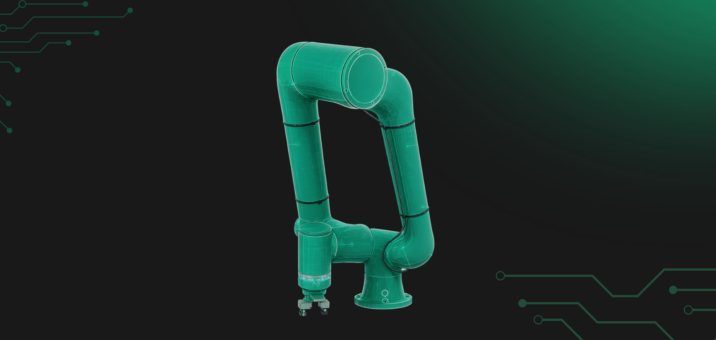
The workstation looks inconspicuous. A robotic arm, a laser head, a camera mounted above the worktable. Yet behind this setup are dozens of hours of testing, several attempts at synchronizing protocols, and one fundamental question we ask ourselves more and more often: why do so many production facilities still rely on humans to perform tasks that machines can do more accurately, faster, and without the risk of fatigue-related errors?
The project we describe did not come from a catalog or an integrator’s ready-made offer. It came from observing our own process. And that is precisely why it is worth describing.
Starting point: repeatability that comes at a cost
Long hours of laser cutting require focus. It is precise, responsible, and inherently monotonous work. A human is not a machine – and should not be one. Prolonged repetition leads to reduced concentration, micro-deviations, and errors which, in production requiring tolerances of 0.05 mm, have real consequences: defects, complaints, and material losses.
The problem was specific, and the solutions available on the market were either so expensive that they were not financially viable, or insufficient in quality. Vision systems for lasers exist, but those meeting our requirements are priced far above the economic threshold for a project of this scale. The decision was therefore logical: build our own workstation.
Vision system as a foundation – the laser had to “see” first
The first step was installing a vision system on the laser. A high-resolution camera was synchronized with the machine control system so that the laser could “see” the material and position itself with precision impossible for an operator working continuously for eight hours.
The results of the first tests were clear – perfect cutting lines, and tolerance maintained in every cycle. The project moved from “we have an idea” to “we are operational.”
It was also the moment when one key engineering principle proved itself again: a vision system is the foundation of precision automation. A robot without “eyes” operates based on programmed coordinates. A robot that can see operates based on reality.
The cobot enters the process – and the real challenge begins
The next step was obvious: adding a cobot to handle material loading and unloading. The robotic arm and laser were integrated into a single control program.
This integration turned out to be an engineering challenge. Synchronizing two devices with different communication protocols, control logic, and error tolerances required dozens of hours of testing, adjustments, and iterations.
It is worth stating clearly: a cobot is not a traditional industrial robot. It does not require cages or costly protective infrastructure. It is designed to work alongside humans, reacts to their presence, and can be reprogrammed without involving specialists in complex robotic languages. This flexibility made it the right choice for a workstation designed to operate automatically, repeatedly, and within defined tolerances.
Why automation matters – reasons that cannot be ignored
Our project is just one example, but the arguments for automation are universal and apply to any production facility, regardless of industry.
Humans should not be machines
Repetitive, long-duration operations negatively affect health and concentration. Monotony leads to errors, which can be costly for both the company and the employee. Automation frees people from exhausting work and allows them to focus on tasks requiring experience, judgment, and thinking.
Consistent performance and scalability
A machine operates with the same precision in the first and eighth hour of a shift. Once designed, a workstation can be replicated or expanded relatively easily – much faster and more cost-effective than recruiting and training additional operators.
Safety and data as by-products of automation
Reducing direct human contact with laser cutting processes is a matter of responsibility. At the same time, an automated workstation generates data: operation times, deviations, failures, tool wear. This data enables continuous improvement and predictive maintenance.
Additional factors to consider in any automation decision:
- elimination of human errors in quality-critical processes
- production predictability as a foundation for meeting deadlines
- reduced risk of workplace accidents in high-risk environments
- development of organizational competencies for future implementations
- maintaining competitiveness in an industry where automation is becoming standard
Conclusions from the first in-house implementation
It is not always necessary to buy ready-made solutions. In-house integration is more difficult and time-consuming, but it provides full control over the system and deep understanding of its operation. This knowledge pays off in every subsequent project.
Our implementation also leads to several organizational conclusions:
- a vision system is essential for effective automation
- a tolerance of 0.05 mm does not allow for “by-eye” work
- the cobot and operator form a team
In our case, the experienced laser operator remains at the workstation. Their role shifts to supervision, optimization, and handling exceptional situations. The cobot takes over repetitive tasks. The result: higher productivity with the same staffing level.
The first step is always the hardest. Integration was a challenge, but now each future project will be easier because the competence remains within the organization.
At Qwerty, automation starts with a question, not a catalog
In designing production workstations, there is no room for off-the-shelf thinking. Every process has its own specifics: different tolerances, environments, repeatability requirements, and scale.
The workstation described in this article was created because no ready-made solution met our requirements at a reasonable quality-to-cost ratio. We built it ourselves – camera, laser, cobot, and unified control system – and we understand exactly how every component works.
This approach defines how we think about projects for our clients. We do not start with an offer. We start with a question: which processes do you repeat most often, and where do you lose the most time or material? The answer usually points precisely to where automation makes sense – and what scale it should take.