Go back
  December 22 2025
 When a military drone pilot sits at a control console, one of the most underestimated elements of the entire system stands between them and an aircraft flying hundreds of kilometers away — the keyboard. It must operate flawlessly in 40-degree desert heat, under the vibrations of an armored vehicle, and in the stress of a combat mission. It must not reveal the operator’s position through electromagnetic emissions. It must not fail at a critical moment.
Ground Control Stations (GCS) are complex systems combining advanced software, data links, and high-precision displays. Yet the keyboard remains the primary human–machine interface through which the operator issues commands, monitors flight parameters, and manages weapon systems. Let’s examine the requirements imposed by military applications and how engineers address these challenges.
An unforgiving operating environment
Drone control stations operate in conditions that would quickly destroy standard office equipment. Mobile GCS units, often transported in rugged Pelican-type cases, must function reliably in radically different environments — from the desert heat of the Middle East to Arctic cold and the high humidity of tropical forests.
Military standards clearly define minimum requirements. MIL-STD-810 specifies resistance to shock, vibration, and extreme temperatures. Keyboards must operate reliably from −40°C to +70°C while maintaining full functionality. MIL-STD-461 addresses electromagnetic compatibility — the keyboard must neither generate interference nor be susceptible to external electromagnetic radiation.
Sealing is another critical parameter. IP67 or higher has become standard — complete protection against dust and the ability to survive immersion in water up to one meter for 30 minutes. In practice, this means membrane-based constructions where conductive traces are hidden beneath a flexible surface, with no gaps between keys.
Invisible to the enemy
A crucial but less obvious requirement is TEMPEST protection — safeguarding against unintentional electromagnetic emissions. Every keystroke on a conventional keyboard generates a characteristic electromagnetic impulse. A sufficiently equipped adversary could not only detect the presence of a GCS but, in some cases, even reconstruct entered commands.
For this reason, military keyboards use advanced EMI/ESD shielding systems. Multi-layer constructions incorporate conductive foils — aluminum layers, copper meshes, or printed silver conductive coatings — forming a Faraday-cage-like structure. Electromagnetic radiation is contained within the keyboard and prevented from leaking outside.
For transparent areas, such as windows above displays, special ITO (Indium Tin Oxide) films are used. These are both electrically conductive and optically transparent. While costly, such solutions are essential in military applications where operational security is paramount.
Night visibility without position disclosure
Drone operators frequently work at night using night-vision goggles. Standard LED backlighting becomes a serious issue — through night-vision devices it appears as a blinding light source, hindering operation and potentially revealing position.
The solution is NVIS (Night Vision Imaging System) technology — specially filtered backlighting compatible with night-vision equipment. Keyboards compliant with NVIS Green B standards use filters that eliminate wavelengths amplified by night-vision devices, preventing the “bloom” effect — the glowing halo around illuminated keys.
These systems allow precise brightness control over a wide range — from 0 to 20 nits or even lower. Operators can fully disable backlighting for maximum discretion or fine-tune it to ambient lighting conditions.
Designed for maximum reliability
Military keyboards are typically membrane or elastomer constructions composed of multiple precisely engineered layers. The top layer is usually polycarbonate or polyester — materials resistant to abrasion, scratching, and chemical exposure. Beneath lie conductive layers, often flexible printed circuits on Kapton (polyimide) substrates or traces made from silver or carbon-based conductive inks.
Switch lifespan is critical. While consumer keyboards are designed for 50,000–100,000 keystrokes, military standards often require 5–10 million cycles per key. Some designs use metal dome switches, providing distinct tactile feedback and exceptional durability.
Optical bonding — permanently joining layers by eliminating air gaps — further enhances mechanical strength and improves label visibility under varying lighting conditions.
Ergonomics under time pressure
In drone control stations such as those for the MQ-1 Predator or MQ-9 Reaper, operators use the HOTAS (Hands On Throttle And Stick) layout familiar from fighter aircraft. While joysticks and throttles handle most critical inputs, the keyboard remains essential for mission data entry, coordination with other units, and sensor management.
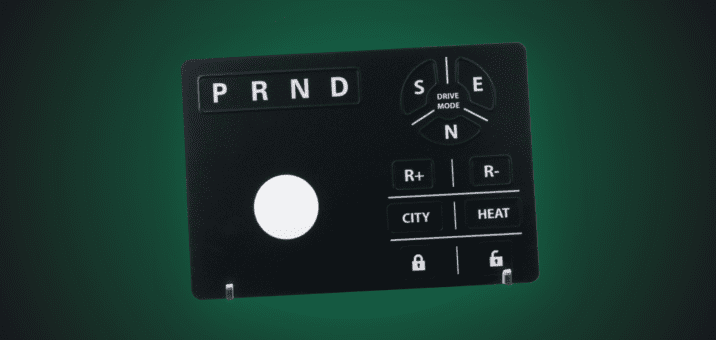
Keyboard layouts in military GCS systems are often custom-designed for specific tasks. Frequently used functions have dedicated, clearly marked keys positioned for blind operation. Some keys feature different surface textures, allowing tactile identification — crucial during night operations.
Modern systems also include programmable function keys that can be adapted to mission requirements. Touch and gesture interfaces are emerging as supplements, but in demanding conditions — with tactical gloves or under vibration — physical keys still offer superior reliability.
Technology that cannot fail
Keyboards in military drone ground control stations represent the essence of engineering under extreme requirements. They must combine resistance to harsh environments, invisibility to enemy detection systems, night-vision compatibility, and absolute reliability over years of intensive use.
This is technology that operates in the background — rarely noticed when discussing advanced unmanned systems. Yet it is precisely this interface that determines whether an operator can effectively control the aircraft, whether the system responds at a critical moment, and whether the mission succeeds.