Go back
  February 16 2026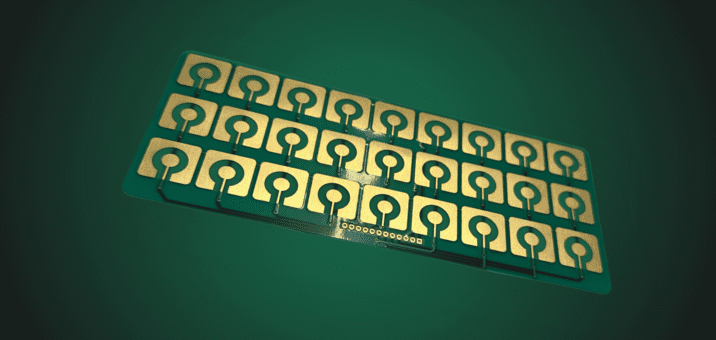
PCB membrane buttons are an advanced technical solution that combines the functionality of traditional membrane switches with the capabilities of printed circuit boards (PCB – Printed Circuit Board). As a manufacturer of specialized interfaces for industrial and medical applications, we observe a growing demand for these components, especially in diagnostic devices and industrial automation systems.
In this article, we explain the operating principles and production technology of PCB membrane buttons. These seemingly inconspicuous components have become a standard wherever control precision, space efficiency, and resistance to harsh operating conditions are required.
Structure and operation of membrane buttons
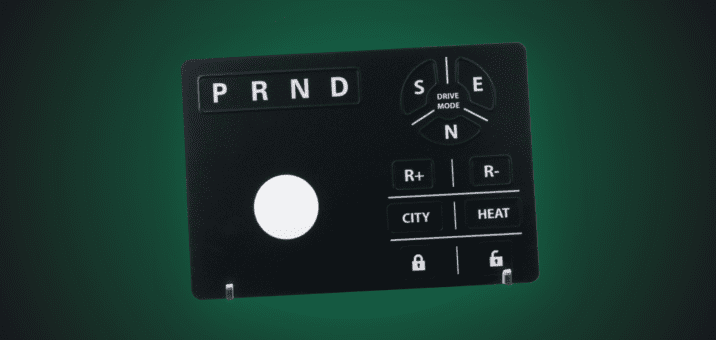
Membrane buttons are advanced flat user interfaces that operate by closing an electrical circuit when pressed. They are commonly used in control panels for medical equipment, industrial machinery, and advanced measurement devices.
At Qwerty’s laboratory, membrane button production is based on combining durable polymers, conductive materials, and effective insulators. The outer polycarbonate or polyester film protects the internal components and carries precisely printed graphics that remain legible for years of use. The core structure consists of conductive layers responsible for signal transmission when the button is pressed, while specialized insulating materials between them eliminate the risk of accidental short circuits. Mechanical stability of the entire structure is ensured by the base layer, which protects the assembly against deformation even under intensive use.
What is a PCB?
Printed circuit boards (PCB – Printed Circuit Board) form the foundation of all modern electronic devices. This seemingly simple component enables:
- Interconnection of various electronic components (resistors, capacitors, diodes, transistors) into a single system.
- Space minimization thanks to multilayer constructions.
- Simplification of mass production through standardization.
- Durability and stability of electronic connections.
In electronics manufacturing, PCBs act as an integration platform – precisely defined conductive tracks connect individual components into a coherent electronic system. Multilayer PCB technology makes it possible to significantly reduce device dimensions while maintaining connection reliability.
PCB membrane buttons – how do these two technologies work together?
Combining membrane buttons with PCBs creates an advanced user interface that exceeds the capabilities of traditional solutions. Several integration methods exist, adapted to specific application requirements.
The basic method involves mounting membrane buttons directly onto the PCB. A significant improvement is achieved by transferring conductive traces from the membrane layer directly onto the printed circuit board. Eliminating flexible conductive foils results in key technical benefits:
- Mechanical durability – PCBs, unlike flexible foils, maintain dimensional stability even under intensive use. The rigid structure protects conductive tracks from micro-cracks that may occur in traditional membrane switches.
- Operational precision – PCB-manufactured conductive traces offer much higher precision than those printed on flexible materials, resulting in more stable electrical parameters and predictable interface behavior.
- Integration potential – PCB technology allows additional functions to be implemented within a single assembly. LED backlighting, capacitive sensors, and control microcontrollers can be integrated while maintaining compact module dimensions.
- Simplified construction – transferring conductive paths to the PCB reduces the number of layers in the membrane button. This increases reliability and simplifies production and assembly.
Advantages of PCB membrane buttons
The combination of membrane technology and PCB creates a solution that significantly outperforms traditional user interfaces and offers numerous advantages.
Precision and reliability
PCB membrane buttons provide exceptional accuracy in registering presses. Carefully engineered construction ensures immediate response with consistent actuation force. These properties make the technology ideal for medical devices, aviation control systems, and advanced industrial automation.
Compact dimensions
PCB membrane buttons feature an ultra-low-profile design. Direct integration with the PCB eliminates the need for additional mounting components, enabling compact device designs without compromising functionality. This is especially important in portable diagnostic devices and control panels.
Resistance to industrial conditions
PCB membrane technology performs well in demanding industrial environments. The sealed structure protects electronics from moisture and dust, while special protective coatings provide resistance to chemicals. The buttons retain full functionality even under intensive use in harsh conditions.
Design versatility
PCB membrane buttons offer wide customization possibilities:
- Individually designed user interface graphics
- Integrated LED backlighting for improved readability
- Implementation of haptic functions and touch sensors
- Direct integration with control electronics
Easy system integration
PCB membrane buttons are easy to implement in electronic systems. Their modular design and compliance with industrial standards simplify device design and assembly. Direct connection to the main PCB eliminates intermediary components, improving overall system stability.
The durable construction and resistance to mechanical damage mean that these interfaces require virtually no regular maintenance. This results in lower operating costs and longer maintenance-free device lifetimes.
A new level of precision with PCB membrane buttons
PCB membrane button technology proves that seemingly contradictory requirements can be combined effectively – high precision with durability, compact dimensions with advanced functionality, and ease of use with reliable operation. This innovative design offers ideal solutions for industry, automation, and medical applications.
At Qwerty, we specialize in designing and manufacturing membrane buttons that meet the highest quality standards. Our solutions are used wherever control precision must go hand in hand with resistance to harsh operating conditions. Multilayer construction, high-quality materials, and advanced production processes enable us to deliver user interfaces that not only meet but often exceed customer expectations.