Go back
  July 14 2026
Somewhere over Belgium, a bird is flying; it doesn’t know flight paths or weather forecasts, but it has something no navigation system can faithfully replicate – a magnetic map of the world encoded in its genes, and a homing instinct that works regardless of wind, rain, or temperature. When it reaches its destination after several hours, or a dozen or more, its owner will ask just one question: what time did it cross the threshold of the loft?
In pigeon racing, the result depends on calculated velocity – the ratio of the distance between the loft and the release point to the flight time, expressed in meters per minute to two decimal places. With thousands of birds released at once, a difference of a single second can change the standings.
Behind the seemingly simple question “what time?” lies an entire chain of engineering decisions – from the entry antenna to the interface the breeder uses to confirm the arrival. Every link in that chain has to withstand conditions that no manufacturer of office electronics would ever even consider.
Not a race, but precision – what pigeon racing really is
Competitive pigeon racing runs on a principle that surprises outsiders: the winning bird is the one with the highest velocity, not the one that reaches its loft first. The distance between the loft and the release point is measured individually for every participant, spherically – accounting for the curvature of the Earth. Flight time is counted down to the second and corrected for the time difference, meaning the gap between the breeder’s clock and the reference clock, verified by the race committee once the flight is over.
It’s a sport in which administration and technology matter just as much as the bird itself. And it all comes down to one question: did the measuring device work flawlessly?
The rubber ring and the mechanical clock – where we came from
For decades, arrival times were recorded by hand, and the result depended on a person’s speed and skill. Today that’s no longer necessary, because the job has been taken over by extremely sensitive measuring devices.
A keeper’s reflexes instead of system precision
For most of its history, pigeon racing relied on a method that demanded lightning-fast reactions from the breeder. The bird returned to the loft, the owner caught it, removed the rubber ring bearing a unique number from its leg, and inserted it into a mechanical timing clock. The clock stamped the arrival time onto a paper tape that the race committee had sealed before the start.
The system worked for decades, but it had one flaw: the result depended on how quickly a human being reacted. Startled birds evaded capture – every second spent chasing one around the loft was a real loss in the standings. With prizes running into the tens of thousands of euros, and today with auction records reaching $1.9 million for a single bird, methods based on manually catching a bird and a mechanical clock stopped being proportionate to what was at stake.
Electronics arrived not for the sake of modernity, but for credibility
Electronic systems emerged because the previous method had too many points of failure and too few controls. As the sport grew to staggering proportions (half a million people breed pigeons in Taiwan alone), and races began generating prizes counted in the billions of local currency, trust in the result became a value in its own right.
RFID in the loft – how automatic measurement works
RFID (Radio-Frequency Identification) is a technology for identification using radio waves – the same principle as a contactless payment card, except what’s being read is a ring on the bird’s leg. The transponder inside the ring is passive, meaning it needs no battery – it draws its energy from the electromagnetic field generated by an antenna mounted at the loft’s entrance.
When the bird crosses the threshold, the antenna registers its identifier automatically, with no human involvement and no stress for the bird. The time is synchronized with the DCF-77 radio signal or with GPS, and the result is recorded digitally and locked against editing for the duration of the race. During basketing – the official handover of birds to the committee at the collection point before the race – the club antenna assigns each ring a random eight-bit code. The terminal will only accept an arrival if the code it reads matches the one assigned at basketing; a cloned ring without knowledge of the code produces a NOK result, meaning the arrival is rejected as invalid.
The loft as a working environment – parameters no office ever has to meet
Electronic devices are designed with controlled conditions in mind – conditions a loft will never provide.
Ammonia, humidity, and frost at dawn
A loft doesn’t resemble any technical room where electronics designers are used to placing their equipment. Winter temperatures drop below zero; summer ones exceed forty degrees Celsius. Constant exposure to ammonia – a byproduct of droppings breaking down – attacks plastics and seals. Dust and feathers act as an abrasive on every exposed surface.
Electronic rings, under the standards of the International Federation of Pigeon Fanciers (FCI), are expected to remain fully functional for fifteen years. The terminals that work alongside them have to match that level of durability.
A person in gloves, in a hurry, at six in the morning
The breeder operates the terminal in the morning, wearing gloves, just as the birds are coming in, when every second affects the standings. The display has to be readable in poor light. The keyboard has to respond reliably and unambiguously – it can’t freeze or miss a signal because of a dirty surface. These are requirements that are easy to write into a specification. They’re much harder to maintain after the third season of working in ammonia.
The keyboard – an engineering decision, not an aesthetic one
In a brochure, every terminal looks solid. In a loft, after several seasons of working in moisture and dust, it becomes clear what was actually designed for that environment and what only looked the part.
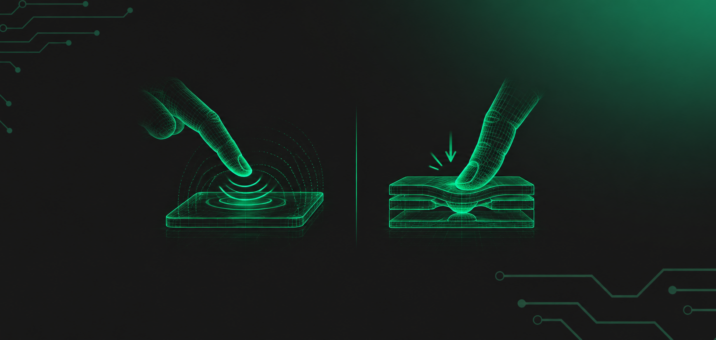
Membrane keyboards, with a continuous surface free of gaps or protruding mechanical parts, leave moisture and dust nowhere to accumulate. Subsurface printing – graphics printed from the underside of the foil – means the key markings resist wear regardless of how intensively the device is used. Stainless steel domes beneath the foil – spring elements that respond to a press with a distinct click – give the breeder unambiguous tactile confirmation that a command was registered, even through thick gloves. Sealing at IP65 or higher means full protection against dust and resistance to a jet of water. In the food or medical industries, these are baseline requirements; in a loft, they’re a guarantee of years of operation.
The credibility of the result starts with the physics of the device
Electronic timing solves the problem of accuracy, but it opens up a new question: how do you make sure the result can’t be faked? The answer lies in the physical construction of the device and in its software.
A seal, a hologram, and a locked BIOS
A system is only as credible as it is hard to bypass. The terminal’s housing has to reveal any attempt at unauthorized opening – marks on the manufacturer’s hologram or broken seals are a warning sign for the technical committee. The device’s BIOS (built-in startup software, the equivalent of a computer’s “boot system”) has to block the installation of unauthorized code. Poland’s Association of Pigeon Fanciers only allows specific terminal models running approved software versions to compete; the absence of homologation or a broken seal disqualifies the device from the competition.
When real money is on the line, technical parameters stop being a formality
FCI requirements for electronic systems cover more than twenty parameters – from the mechanical resistance of the ring to cryptographic safeguards (data encryption that prevents unauthorized modification). The ring has to survive a drop of 1.2 meters onto a steel plate. The operating temperature range runs from minus five to plus fifty-five degrees Celsius. Data stored on the chip has to remain intact for at least ten years. Every one of these parameters is settled not in the manufacturer’s laboratory, but in the loft, while the race committee waits for results.
How this looks at Qwerty
At Qwerty, we look at the keyboard for a racing terminal as part of a timing system, not as a separate product with its own standalone specification. The design starts with an analysis of the environment – not with a catalog.
When selecting solutions for systems like TauRIS, we take into account:
- the thermal and humidity conditions of the operating environment,
- chemical resistance to ammonia and to the cleaning agents used in lofts,
- the required sealing class for the housing and interface,
- activation force and the nature of tactile confirmation when operated in gloves,
- the durability of key markings under intensive, multi-year use,
- dimensional and electrical compatibility with the specific terminal model.
The membrane keyboards that go into racing systems are, today, at work in lofts across Germany, Belgium, Poland, and China – everywhere a race committee refuses to accept an interface failure as an explanation for a missing result. And there are many more markets out there where expectations for reliability run just as high.
A sport that teaches humility toward the environment
A pigeon covers hundreds of kilometers guided by instinct and a magnetic map of the world, through rain, wind, and heat – with no power source, no signal, no way to report a malfunction. Its result depends on whether the electronics on the other end work flawlessly in a humid, dusty, chemically aggressive environment, at dawn, season after season.
Pigeon racing is an industry that ruthlessly tests whether declared standards actually hold up in the field. You won’t see that difference on a spec sheet, but you’ll see it after a few years of use.