Go back
  February 16 2026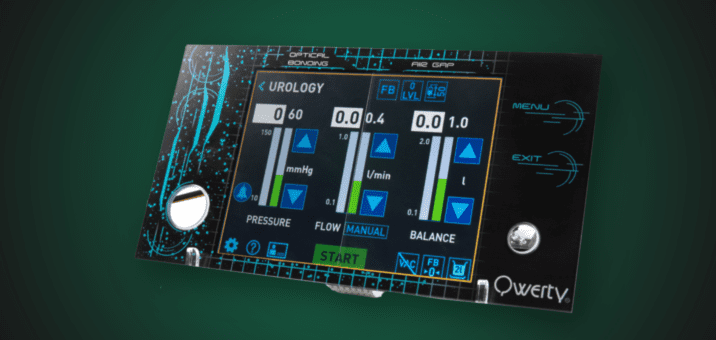
Touch panels are everywhere – from medical devices and industrial control panels to military systems. With every new project, the requirements for durability and image quality continue to grow. The answer to these needs is optical bonding technology, which at Qwerty we use to manufacture panels that are exceptionally resistant to mechanical damage while offering excellent image readability in all lighting conditions.
Optical bonding is a process of permanently joining the layers of a touch panel, eliminating air gaps between them. This seemingly simple method delivers impressive results – it improves the optical performance of the display and significantly increases its mechanical strength. In this article, we show how we use this technology in our projects and what specific benefits it brings to end users.
What Is Optical Bonding?
Optical bonding is an advanced method of joining optical components that completely eliminates air gaps between the layers of a touch panel. The process uses specially developed optical adhesives to permanently bond the display, the touch layer, and the protective glass.
Traditional assembly methods leave microscopic air gaps between layers. These seemingly insignificant spaces have a major impact on usability – they cause light reflections, reduce image contrast, and weaken the mechanical structure. By using optical bonding, these spaces are filled with adhesive whose optical properties are matched to the surrounding materials.
The result? A monolithic structure in which all layers work together, ensuring excellent image readability and high impact resistance.
How Does Optical Bonding Work?
Optical bonding is a process in which carefully selected optical adhesives bond individual layers of a touch panel into one coherent unit. Two types of materials are used for this purpose:
- OCA (Optically Clear Adhesive) films
- LOCA (Liquid Optically Clear Adhesive) liquid adhesives
The process begins with thorough cleaning of all bonded surfaces. In the case of LOCA, the liquid adhesive is precisely dispensed onto the panel surface. OCA adhesives are applied like advanced adhesive films – layer by layer. Every stage requires extreme precision, as even the smallest contamination or air bubble can affect the optical performance of the entire assembly.
After application, the adhesive is cured using UV radiation or elevated temperature – the method depends on the type of adhesive and the intended application of the panel.
At this stage, the adhesive forms a transparent, durable layer that maintains its properties throughout the entire service life of the panel – it does not yellow, does not lose clarity, and effectively protects the interior of the device from moisture and contaminants.
The result of this precise process is a touch panel with significantly improved parameters – more resistant to mechanical damage and offering excellent visibility of displayed content even in difficult lighting conditions.
How Does Optical Bonding Improve Touch Panel Quality?
The use of optical bonding significantly improves touch panel performance in terms of both image quality and mechanical durability. Compared to traditional assembly methods, this technology brings tangible improvements in many areas of use.
Improved Image Quality
The optical parameters of a touch panel are fundamental to user comfort. Optical bonding delivers the following improvements:
- Reduced light reflections – eliminating the air layer between the display and the touch panel significantly reduces external light reflections, ensuring excellent readability even in bright sunlight
- Higher image quality – bonding the layers increases contrast and color saturation, making displayed content clearer and more detailed
- Elimination of optical distortion – replacing the air layer with optical adhesive prevents the “haze” effect that can degrade visibility
These improvements are especially valued in devices operating in changing lighting conditions, where good screen readability is crucial.
Increased Durability and Resistance
Optical bonding not only improves image quality – it also significantly strengthens the panel structure:
- Resistance to impacts and vibrations – the integrated structure disperses shock energy more effectively, protecting delicate electronic components
- Protection against contaminants – the absence of gaps between layers eliminates the risk of dust and moisture ingress
- Reinforced mechanical structure – bonding the layers into a single unit increases resistance to deformation and surface damage
This reinforced construction significantly extends the service life of the device and reduces the risk of failure.
Better Usability
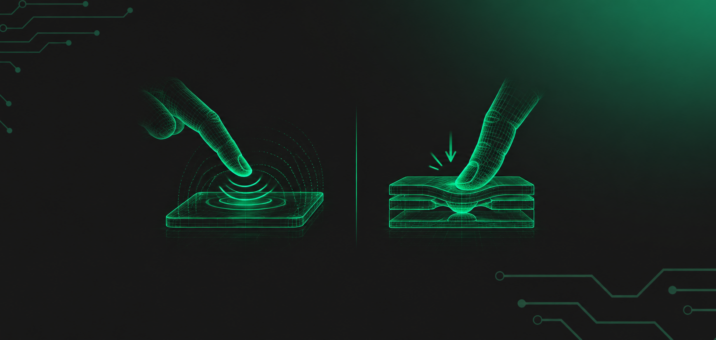
Optical bonding improves not only durability but also the usability of touch panels. Eliminating the air gap between the touch surface and the display results in more precise and natural touch response. The panel reacts faster and more accurately to user input, improving overall user comfort.
Additionally, reduced internal reflections ensure that the image remains clear regardless of viewing angle.
Operation in Harsh Conditions
Panels manufactured using optical bonding technology perform well in the most demanding applications. Proper selection of adhesive materials ensures stable operation across a wide temperature range and resistance to UV radiation. This is particularly important for devices used outdoors or in harsh industrial environments.
The hygienic aspect is also worth noting – a smooth, gap-free surface is easy to clean and disinfect. This is a major advantage in medical and food-industry applications, where hygiene is critical.
Optical Bonding – A Proven Technology in Qwerty Products
At Qwerty, we have been using optical bonding for years as a proven method of manufacturing touch panels with enhanced performance parameters. This technology allows us to deliver devices that meet the most demanding requirements – from medical panels, where precision and ease of disinfection are essential, to industrial systems operating in harsh environmental conditions.
Optical bonding is much more than just a method of joining panel layers – it is a comprehensive solution that improves image quality, increases mechanical durability, and enhances user comfort. Eliminating air gaps between layers translates into better display readability, greater resistance to damage, and more precise touch response.