Go back
  February 16 2026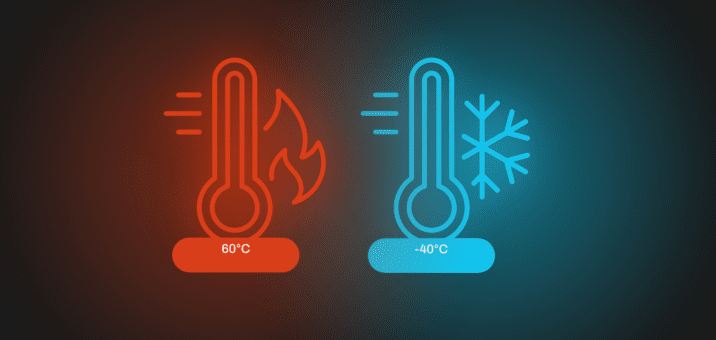
Thermal Reliability of Industrial Keyboards – How Qwerty Ensures Stable Operation in Extreme Temperatures
For over 35 years, Qwerty has been designing industrial keyboards capable of operating in the most demanding working environments. One of the key challenges we face every day is ensuring stable device performance in extreme temperatures – from freezing logistics warehouses to overheated production halls.
Our long-term experience has enabled us to develop advanced technological solutions that guarantee keyboard reliability even under extreme thermal conditions. By combining innovative materials, precise manufacturing processes, and rigorous testing in our R&D laboratory, we deliver products that set thermal performance standards in their class.
In this article, we take a closer look at the technologies and materials behind the thermal reliability of our industrial keyboards.
Why Is Thermal Performance So Important?
Industrial keyboards operate daily in highly demanding thermal conditions. In production halls, temperatures often exceed 60°C, accelerating the aging of electronic components and potentially causing material deformation. In industrial freezers or military applications, temperatures can drop below –30°C, leading to mechanical brittleness and electrical conductivity issues.
Insufficient thermal resistance may result in:
- control system failures that halt production,
- unstable interface operation in medical equipment, threatening patient safety,
- high downtime and repair costs,
- critical process errors due to loss of precision.
This is why selecting proper materials and technologies must be combined with thorough laboratory testing before installation in real-world environments.
Advanced Structural Materials
Designing keyboards for extreme temperatures requires careful material selection. Materials must withstand temperature extremes as well as mechanical stress and changes in physical properties.
High-grade polycarbonates form the foundation of our designs, offering excellent resistance to mechanical, thermal, and chemical factors. Precisely tailored material behavior under temperature fluctuations prevents:
- internal structural stresses,
- loss of enclosure sealing,
- interference with key mechanisms,
- deformation of working surfaces.
Additional protection is provided by specialized protective coatings that enhance thermal resistance and shield the keyboard from aggressive industrial chemicals.
In our laboratory, we have developed a proprietary material composition that significantly outperforms standard market solutions. Qwerty industrial keyboards installed in steelworks and power plants operate continuously at high temperatures while maintaining full functionality and precision.
Next-Generation Design Technologies
Creating keyboards resistant to extreme temperatures requires a comprehensive engineering approach that protects devices from overheating and excessive cooling while maintaining full functionality.
Layered Construction
The thermal resistance of industrial membrane keyboards results from their carefully designed multilayer structure. Each layer plays a specific protective role, forming a robust thermal barrier for sensitive electronic components.
The outer layer uses advanced materials such as polycarbonate, which retain dimensional stability and mechanical strength even at extreme temperatures and resist degradation from UV radiation.
The conductive core layer, typically made of copper or silver, provides excellent electrical conductivity and low thermal expansion, preventing damage to conductive traces during temperature fluctuations.
The base layer, made from temperature-resistant elastomers, provides thermal insulation and vibration damping. It prevents heat generated by electronic components from transferring to the surface, improving user comfort and protecting operators from burns.
Innovative Thermal Protective Coatings
Effective surface protection requires advanced material technologies:
- ceramic nano-coatings with thermal resistance up to 150°C,
- multi-layer fluoropolymer coatings resistant to aggressive industrial environments,
- specialized thermal insulation layers reducing heat transfer,
- hybrid coatings combining thermal and mechanical protection.
At Qwerty, we have developed our own ceramic coating application technology, ensuring exceptional thermal resistance while preserving permanent marking durability throughout the product lifecycle.
Heat Flow Optimization
Computer simulations are used to analyze thermal flow, enabling us to:
- identify overheating hotspots,
- optimize cooling element placement,
- select materials with suitable thermal properties,
- design efficient ventilation paths.
The combination of layered construction, advanced coatings, and thermal control systems creates a robust defense against overheating and overcooling, ensuring reliable operation even in the harshest industrial environments.
Testing Under Extreme Conditions
Each industrial keyboard undergoes extensive laboratory testing to validate the effectiveness of implemented thermal solutions.
Climate Chamber Testing
Keyboards are exposed to temperatures ranging from –40°C to +60°C, including cyclic thermal changes. Additional tests include high-humidity conditions (up to 95% RH) and exposure to aggressive chemicals, accurately simulating real industrial environments.
Thermal Shock Resistance
Devices undergo rapid temperature transitions between –40°C and +60°C. Mechanical and electrical connections, as well as enclosure sealing, are closely monitored to ensure structural integrity under extreme thermal stress.
Precision Thermal Diagnostics
Advanced measurement equipment maps temperature distribution across the keyboard, detecting potential problem areas. Electrical parameters are continuously monitored, and accelerated aging tests reveal long-term material behavior.
Long-Term Durability Tests
Accelerated life testing simulates years of operation through intensive thermal cycling. Protective coatings and markings are verified to remain fully functional throughout the product’s lifespan.
All results are documented and analyzed by engineering teams, enabling continuous optimization of both design and manufacturing processes.
Thermal Durability of Qwerty Membrane Keyboards
Membrane keyboards rely on precisely engineered conductive and insulating layers. While the technology appears simple, it demands extreme manufacturing precision and specialized materials to ensure reliability in harsh environments.
Our R&D laboratory continuously pushes technological boundaries. Proprietary thermal solutions enable flawless operation in extreme temperatures, setting a benchmark in the industry. The patented multilayer construction effectively insulates electronic components in environments ranging from industrial freezers to steel furnaces.
As an industry leader, Qwerty has introduced unique thermal protection technologies. Our proprietary ceramic coatings ensure exceptional resistance to extreme temperatures while preserving marking durability. Each keyboard undergoes thousands of thermal cycles in climate chambers—far exceeding standard industry requirements.
Long-term cooperation with leading energy, steel, and defense companies confirms the effectiveness of our solutions. Qwerty membrane keyboards operate continuously in critical industrial installations where interface stability is essential for safety and production continuity.
Qwerty Keyboards – Reliability at Any Temperature
Over three decades of experience in industrial keyboard design have enabled Qwerty to deliver products with exceptional thermal resistance, operating reliably across extreme temperature ranges. Every component—from protective coatings and multilayer structures to thermal management systems—has been optimized in our laboratories and validated in real-world deployments across steel, energy, and defense sectors.
Rigorous climate chamber testing and continuous technological improvement have made Qwerty keyboards synonymous with reliability in the most demanding industrial applications.