Go back
  January 8 2026
 In modern manufacturing plants, touchpads are revolutionizing machine control by replacing traditional buttons and knobs with intuitive touch-based interfaces. Operators can now manage complex technological processes with a single touch, adjust production parameters in real time, and monitor entire production lines from a single panel. This represents a major step forward in ergonomics and operational efficiency.
However, industrial environments pose brutal challenges for touch technology. While consumer-grade touchpads operate in air-conditioned offices or homes, industrial interfaces must function in temperatures reaching several hundred degrees Celsius, in the presence of aggressive chemicals, under constant machine vibrations, and in atmospheres saturated with metallic dust. An IP65 rating is the absolute minimum—many applications require even higher levels of protection.
A failure of a touchpad controlling a production line in an automotive factory can cost tens of thousands of euros per hour of downtime. In a chemical plant, a damaged interface can lead to dangerous emergency situations. That is why industrial touch solutions require specialized technologies and materials that guarantee reliable operation under the most extreme conditions.
Challenges for Touchpads in Industry
Touchpads used in manufacturing facilities must withstand conditions that would destroy standard touch devices within days. Practical experience shows that the greatest threats are not only obvious mechanical factors but also less visible material degradation processes.
Moisture and Industrial Dust
Textile factories, food processing plants, and steel mills generate enormous amounts of dust and moisture. Conventional touchpads quickly lose responsiveness when metallic dust, flour, or other industrial substances settle on their surface. Testing in chambers simulating extreme dust exposure shows that some devices stop responding after only a few hours.
Moisture is an equally serious issue. In food processing plants and the chemical industry, touchpads must operate at humidity levels exceeding 90%. Consumer-grade solutions under such conditions often register false touches or stop responding altogether.
Mechanical Impacts and Vibrations
Industrial machinery generates intense vibrations that can damage the delicate layers of a touchpad. In steelworks and machine factories, accidental impacts from tools or heavy objects are an additional risk. Studies show that an industrial touchpad must withstand impacts of at least 50 J to be suitable for harsh environments.
Chemicals and Cleaning Agents
Regular cleaning with disinfectants in the food and pharmaceutical industries damages touchpad surfaces not designed for such conditions. Solutions containing alcohol or chlorine are particularly aggressive, causing degradation of the touch layer after just a few weeks of use.
Technologies Supporting Industrial Touchpads
Designers of industrial touchpads have developed innovative solutions tailored to the specific challenges of production environments.
Multi-Layer Construction Resistant to Damage
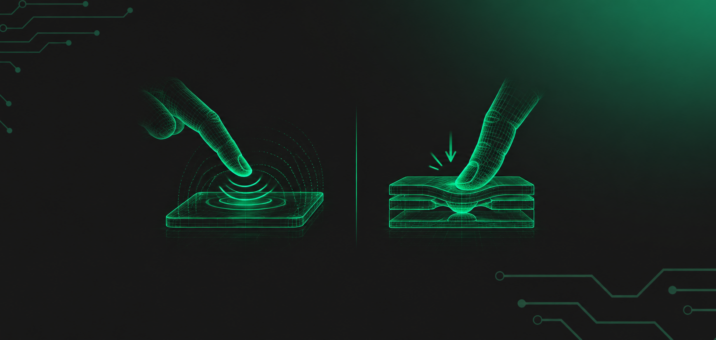
Modern industrial touchpads use specialized multi-layer constructions consisting of several functional layers. The outer layer is a high-strength polycarbonate with an anti-reflective coating, protecting against scratches and impacts. Beneath it is a conductive layer produced using printed conductive materials.
This construction allows the touchpad to function even after surface damage. In practice, this means the device can continue operating without issues despite visible scratches formed after years of intensive use.
EMI/ESD Shielding Technology
In industrial environments, touchpads are exposed to intense electromagnetic interference from motors, welding equipment, and high-frequency devices. Advanced EMI/ESD shielding protects electronics from interference and electrostatic discharges.
This solution proves essential in electronics manufacturing plants, where touchpads operate near automated soldering lines. Without proper shielding, devices may register false touches caused by electromagnetic disturbances.
Optical Bonding for Improved Visibility
Working under varying lighting conditions requires excellent display readability. Optical bonding technology eliminates air gaps between screen layers, significantly improving contrast and readability—even in the bright lighting of production halls.
In practice, this means operators can easily read information from the touchpad whether working near a window on a sunny day or in a poorly lit warehouse.
Specialized Protective Coatings
The touchpad surface is coated with a multifunctional layer combining UV protection with antibacterial properties. This coating not only protects against sunlight but also facilitates disinfection in industries requiring high hygiene standards.
Touchpads Across Industrial Sectors
Implementation experience shows how well-designed technical solutions translate into tangible benefits for industrial users.
Food Industry
In meat processing plants, touchpads must withstand frequent high-pressure washing and disinfection. Traditional solutions require replacement every few months, while specialized industrial devices can operate reliably for years. Deployments show up to an 80% reduction in maintenance costs after switching to dedicated industrial solutions.
Dairies present similarly demanding conditions. Touchpads control pasteurization processes at temperatures of 85°C and humidity levels exceeding 95%. HACCP standards require cleaning of entire lines every 4–6 hours using agents with pH values ranging from 2 to 12. In bakeries, additional challenges include wheat flour forming an insulating layer on the touch surface and oven temperatures reaching 300°C.
Industrial Automation
In production lines, touchpads control complex processes where every second of downtime costs thousands of euros. Professional solutions feature response times below 50 milliseconds and reliability exceeding 99.9%.
The automotive industry uses touchpads to control welding robots operating 24/7. The intense electromagnetic field generated by 50 kW welding equipment can completely disrupt unprotected devices, while sparks and metal fragments pose constant threats to surfaces. In electronics manufacturing, positioning accuracy of ±0.1 mm is required, necessitating advanced thermal drift compensation algorithms.
Medical Environments
Hospitals and laboratories require devices resistant to aggressive disinfectants. Specialized touchpads maintain full functionality after thousands of cleaning cycles using chlorine- or aldehyde-based agents.
Operating rooms impose particularly strict requirements—touchpads must withstand sterilization with hydrogen peroxide plasma or ethylene oxide without releasing any toxic substances. In diagnostic laboratories, devices control analyzers requiring stability at parts-per-million levels while remaining resistant to alcohols and organic solvents. Intensive care units additionally require resistance to defibrillator pulses (360 J) while maintaining zero electromagnetic emissions.
Industrial Touchpads – Reliability in the Harshest Conditions
Industrial touchpads are a prime example of how specialized technologies can turn the challenges of production environments into a competitive advantage. Thanks to advanced design and material solutions, modern touch interfaces not only survive extreme conditions but also enhance operational efficiency and workplace safety. It is a solution that combines reliability with intuitive operation, supporting the digital transformation of modern industry.