Go back
  November 19 2025
 Piezoelectric keyboards are a technology that has existed in industry for over three decades, yet they continue to fascinate with their reliability and versatility. At Qwerty, we have been observing a growing interest in these solutions for years, especially in applications requiring absolute precision and long-term operation without failures.
Piezoelectricity is a physical phenomenon in which electrical charge is generated as a result of mechanical pressure applied to specific materials. We use it to create interfaces that respond to touch without traditional mechanical switches. This effect occurs naturally in quartz, but modern keyboards use specialized piezoelectric ceramics with far better parameters.
How Is a Signal Generated in a Piezoelectric Keyboard?
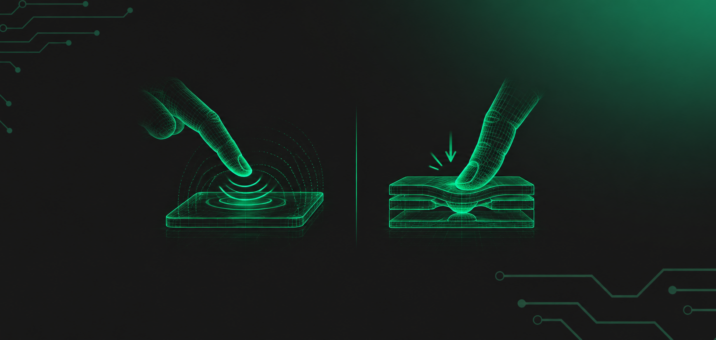
At the core of a piezoelectric keyboard lies a thin layer of piezoelectric ceramic placed beneath the working surface. When a user presses a specific area, the material generates an electrical impulse proportional to the applied force. This signal is then processed by electronic circuits, which interpret it as a specific command.
In our laboratory, we test various configurations of these circuits. The latest solutions allow not only detecting touch itself but also its intensity and duration. This enables a single keyboard to operate a wide range of functions — from simple device activation to precise adjustment of industrial machinery parameters.
The piezoelectric construction eliminates traditional mechanical components such as springs or contacts. The keyboard surface remains flat and hermetically sealed, which is crucial for industrial and medical applications.
Why Piezoelectricity Excels in Industry
Piezoelectric keyboards perform exceptionally well in the most demanding industrial environments. With no moving mechanical parts, they offer virtually unlimited lifespan — laboratory tests confirm flawless operation after tens of thousands of cycles.
Resistance to External Conditions
Piezoelectric keyboards can be fully sealed to achieve protection ratings such as IP67 or IP68. They operate reliably in temperatures ranging from -40°C to +65°C, making them ideal for use in industrial refrigeration rooms, steel furnaces, or outdoor installations.
In our projects for the chemical industry, we additionally use special protective coatings resistant to aggressive chemical compounds. The keyboard surface contains no gaps or recesses where contaminants or bacteria could accumulate.
Precision and Responsiveness
Piezoelectric technology provides exceptional touch detection precision. Adjustable sensitivity levels allow the keyboard to be tailored to specific applications — from delicate interaction in medical devices to strong pressure required when working with protective gloves.
The response time of a piezoelectric keyboard is just a few milliseconds, which is essential for applications requiring immediate system reaction. This is particularly beneficial in machine control systems, where delays can affect product quality.
Applications Across Industries
The versatility of piezoelectric keyboards makes them suitable for virtually every industry requiring reliable control interfaces. Their unique properties — hermetic sealing, resistance to extreme conditions, and long lifespan — make them the perfect choice where traditional mechanical keyboards fail. Below are the most common application areas.
Food and Pharmaceutical Industry
In the food sector, piezoelectric keyboards are standard in production lines requiring frequent cleaning and disinfection. Their smooth surface does not trap food debris, and their resistance to cleaning agents allows the use of aggressive detergents without damaging the electronics.
In the pharmaceutical industry, we use them in laboratories and cleanrooms. The ability to operate without mechanical contact minimizes the risk of contamination, which is crucial for processes requiring sterility.
Medicine and Diagnostics
The medical sector values piezoelectric keyboards for their easy disinfection and resistance to repeated cleaning with bactericidal agents. We use them in diagnostic equipment, ventilators, and patient monitoring systems.
Of particular importance is their usability while wearing disposable gloves — piezoelectric sensitivity ensures reliable operation even with thick surgical or protective gloves.
Industrial Automation
In industrial machine control, piezoelectric keyboards offer unmatched reliability in harsh environments. Their resistance to vibration, dust, and extreme temperatures makes them suitable for metallurgy, mining, and the automotive industry.
Typical applications include control interfaces for cranes, conveyor belts, and industrial robots. The ability to program multiple functions onto a single surface allows operators to intuitively control complex systems.
Transport and Logistics
In the transport sector, piezoelectric keyboards are used in payment terminals, access control systems, and navigation devices. Their weather resistance allows installation in utility vehicles and construction machinery.
Choosing the Right Piezoelectric Keyboard
When selecting a piezoelectric keyboard, it is crucial to match the technical parameters to the intended application. Sensitivity levels, operating temperature, IP protection rating, and mounting method are the core criteria determining the effectiveness of the solution.
Designing a piezoelectric interface requires consideration of environmental conditions and user preferences. For glove-based operation, increased sensitivity is necessary, while applications prone to accidental touches may require higher activation thresholds.
Every project should begin with a detailed requirements analysis and real-world testing. Only this approach guarantees optimal keyboard performance throughout the device’s planned lifespan.
The Future of Piezoelectric Technology
Piezoelectric keyboards are a perfect example of a technology that has consistently proven its value in demanding industrial applications over decades. Their reliability, durability, and versatility make them a top choice for designers of control systems in sectors requiring the highest quality and dependability.
At Qwerty, we believe that continued development of this technology will deliver even more advanced solutions, combining traditional piezoelectric reliability with modern communication and system integration capabilities.