Go back
  March 18 2025
Imagine a control panel of a modern manufacturing machine – a smooth, uniform surface that responds flawlessly to the operator’s touch, allowing precise control of complex technological processes. Behind this apparent simplicity lies advanced capacitive switch technology that completely transforms the way humans interact with machines.
Capacitive switches, although invisible and “transparent” to most users in everyday use, are an example of a precise combination of physics and electronics. From medical devices requiring the highest reliability to control systems in the chemical industry and laboratory equipment, capacitive interfaces are proving their effectiveness, combining durability with intuitive operation.
In this article, we will introduce the operating principles of capacitive switches and explain why they are so popular.
A capacitive switch is an advanced electronic interface element that detects touch by measuring changes in the electric field. Unlike classic mechanical switches, it contains no moving parts – its operation is based on the natural electrical conduction properties of the human body.
At the heart of a capacitive switch is a specialized electronic circuit that detects changes in capacitance. When a finger approaches the sensor surface, it disrupts the local electric field, and a precision microprocessor interprets this change as an activation signal. This technology makes it possible to create completely flat, waterproof control panels that perform well in demanding industrial environments – from sterile laboratories to dusty production halls.
Operating Principles of Capacitive Switches
Capacitive switches use the basic laws of physics on electrical conductivity. Each capacitive switch contains an electronic circuit that monitors changes in the electric field around the sensor surface. When a conductive object – such as a human finger – comes within range of this field, it causes measurable changes in its parameters.
In its simplest form, a capacitive switch uses a single electrode that creates an electric field. This electrode, made of conductive material, is insulated from the environment by a layer of dielectric medium. When a finger approaches the switch, it causes an increase in the electrical capacitance of the circuit. This change is detected by a specialized controller, which converts it into a control signal.
This more advanced solution is based on a system of two electrodes – a transmitting electrode and a receiving electrode. The transmitting electrode generates an electrical signal, which is received by the receiving electrode. Touching the surface of the sensor changes the characteristics of this connection, making it possible to precisely detect not only the touch but also its precise position and intensity.
The key element controlling the capacitive switch is a microprocessor with dedicated software. This system constantly monitors and analyzes signals from the electrodes, filtering out any environmental interference. Advanced data processing algorithms make it possible to accurately distinguish intentional touch from accidental contact or the effects of moisture, guaranteeing stable operation in a wide variety of application conditions.
What Are the Main Advantages and Disadvantages of Capacitive Switches?
Capacitive pushbutton technology was a breakthrough in the design of control interfaces. Their unique technical characteristics translate into practical benefits such as:
● Mechanical durability – the absence of moving parts eliminates issues associated with wear and tear of parts. Switches remain functional even after millions of operating cycles, and the smooth surface without gaps effectively protects the panel from dust and moisture.
● Ease of cleaning – flat design and sealed protective coating prevent dirt accumulation. The ability to disinfect the entire surface makes capacitive pushbuttons suitable for the medical and food industries.
● Design freedom – technology allows sensors to be hidden under a variety of finishing materials, from glass to high-quality plastics. This provides the opportunity to create elegant, minimalist control panels.
● Advanced detection – capacitive sensors detect not only touch but also its intensity and position. As a result, a single panel can handle different functions depending on how it is interacted with.
● Universal application – switches work through layers of non-conductive materials, which allows us to create waterproof and dustproof control panels for difficult environments.
Capacitive technology, despite its many advantages, also poses some technical challenges for designers. First of all, switches of this type require precise calibration of detection parameters – a sensor that is too sensitive may respond to accidental touches. At the same time, too low sensitivity leads to delays in responding to touch. Moreover, strong electromagnetic fields (as well as the presence of water or conductive contaminants on the surface of the panel) can interfere with capacitive sensors, requiring additional protection and shielding.
When designing capacitive interfaces, it is also important to consider that not all insulation materials are suitable. The thickness and electrical properties of the protective layer must be properly selected to maintain optimal sensor sensitivity while providing adequate mechanical protection.
Capacitive Switches vs. Membrane Keyboards – Similarities and Differences
Capacitive switches and membrane keyboards represent two different approaches to control interface design. While they may appear similar at first glance, their operating principle and usage characteristics differ significantly.
Both solutions have in common the lack of classic mechanical switches, which enables quiet operation and compact design. Here, however, the similarities end.
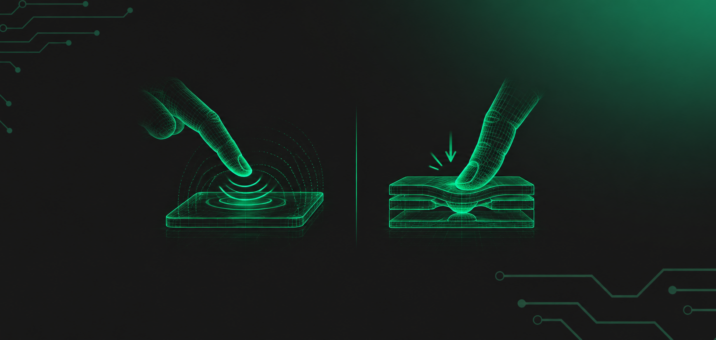
Membrane keyboards require physical pressure to bring two conductive layers into contact and close an electrical circuit. With capacitive technology, simply bringing a finger close to the sensor surface is sufficient.
The differences can also be seen in the design – membranes react to mechanical deformation, which can lead to material wear over time. Capacitive technology, which has no moving parts, offers much longer problem-free operation. In addition, the sealed design of capacitive switches provides better protection against moisture and dust.
Capacitive Switches in Industrial Interfaces – a Summary
Capacitive switch technology is a fascinating example of the harmonious combination of physics, electronics, and consumer engineering. Their innovation lies not only in their precise touch detection without the need for moving parts but also in their ability to adapt to a wide variety of industrial environments – from sterile laboratories to harsh manufacturing conditions. Advanced signal processing algorithms and thoughtful mechanical design allow interfaces of this type to meet the highest quality standards.