Go back
  March 18 2025
Modern industrial production relies on advanced technologies that control production processes, monitor parameters, and optimize equipment operation. In order to effectively manage these complex systems, appropriate tools for communication between man and machines are essential. They are known as HMIs. Understanding their operating principles, as well as their potential, is important for anyone involved in industrial automation or for those planning to upgrade their machinery. This article will explain what exactly HMIs are and how Qwerty keyboards and touch panels support their creation.
Human Machine Interface (HMI) is a system that enables communication between the user and an industrial device or process. Its task is to transform the operator’s actions into specific instructions for the machine and to present data from the device in a form that humans can understand.
HMIs can be found in everyday life – they exist in elevators, vending machines, or household appliances. However, the most advanced applications are in industry, where they allow humans to control complex production lines, monitor machine operation, and respond to incidents in the technological process.
Modern HMIs are much more than displays or control panels. They combine the following functions:
● Real-time visualization of industrial processes.
● Control of machines and entire production lines.
● Monitoring of device operating parameters.
● Alerting for irregularities and malfunctions.
● Collection and analysis of production data.
A well-designed HMI translates complex technological processes into an accessible visual form. The operator can see the current device status, modify production parameters, and receive immediate information about any deviations from the norm. This has a direct impact on the efficiency of the manufacturing process, the detection of potential issues, and work safety.
An HMI is a complex structure that combines many hardware and software components. Each component has a specified role in ensuring effective communication between humans and machines.
An operator panel is the physical part of the interface that is in direct contact with the operator. It can take a variety of forms – from simple membrane keyboards or touch screens to advanced control panels. Ergonomics and adaptation to working conditions determine its effectiveness. The panel must be legible in different lighting, resistant to dirt or vibration, and, at the same time, intuitive.
At the heart of an HMI are hardware components responsible for processing and transmitting data. These are primarily industrial computers, controllers, and communication modules. Their design must meet strict industrial standards – the must be resistant to electromagnetic interference, thermally stable, and have dust and moisture protection.
The HMI software layer is responsible for interpreting operator commands and converting them into instructions for the machine. Modern HMI software integrates with SCADA systems, databases, and analytics platforms. This makes it possible not only to control equipment but also to collect process information and generate production reports.
Efficient data exchange between interface and machine requires reliable communication protocols. Modern HMIs use industry standards such as Modbus, Profinet, or EtherCAT. They provide fast and secure transmission of information, often in real time, which is essential for production processes.
HMIs come in different variants, adapted to specific needs and operating conditions. Their complexity and functionality depend on the application – from simple appliances to advanced control systems.
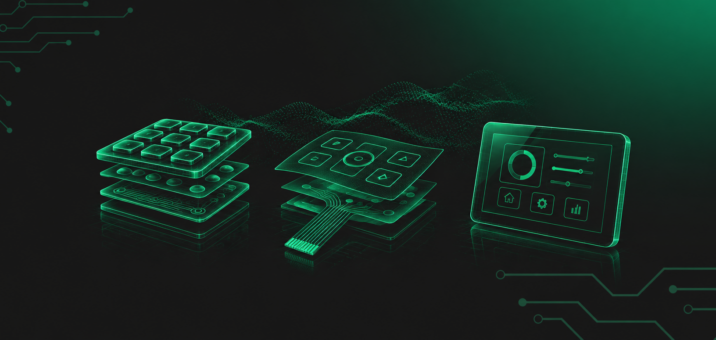
● Basic HMIs – the simplest HMIs consist of keys, LED controls, and segment displays. They work well in applications where simplicity of operation and resistance to harsh environmental conditions are important – in manufacturing machines or industrial elevators.
● HMI touch screens – currently a standard solution for industrial automation. Touch screens are intuitive and flexible when displaying information. The operator can select a variety of function screens, process diagrams, or parameter trends, making it significantly easier to control the production process.
● Advanced HMI systems – the most advanced category of HMIs, combining control, monitoring, and data analysis functions. They work with SCADA systems and databases, enabling comprehensive control of the production process, as well as generating reports and providing trend analysis tools.
● Mobile HMIs – solutions that enable access to control systems through mobile devices. Applications for tablets and smartphones are used for monitoring processes and responding to alarms from anywhere in the plant, which is especially important for maintenance departments.
What Are the Advantages of Human Machine Interfaces?
HMI systems have changed the way production processes are managed, improving the work of both individual operators and entire teams. The introduction of HMIs brings, for example, the following benefits:
● Simple operation of complex processes – graphical interfaces display complex technological processes in an accessible way. The operator does not need to know technical details. He only has to understand the diagrams and indicators shown on the screen.
● Rapid response to incidents – HMIs display alarms, parameter status, and diagnostic messages, allowing operators to respond quickly to anomalies.
● Production optimization – collecting and analyzing production data allows for the identification of process bottlenecks, monitoring material and energy consumption, and planning equipment maintenance.
● Flexibility and scalability – modifying the interface or adding new functions does not require interference with the technological process, which makes it possible to expand the control systems gradually.
Introducing HMI systems can result in reducing onboarding time for new employees, reducing downtime and breakdowns, and improving overall production efficiency. These interfaces are becoming standard in modern industrial plants.
Qwerty Membrane Keyboards and Touch Panels as Part of an HMI
Industrial HMIs require reliable components that allow precise interaction between the operator and the machine. At Qwerty, we specialize in manufacturing two key HMI components: membrane keyboards and touch panels, which provide the physical layer of communication between humans and the industrial system.
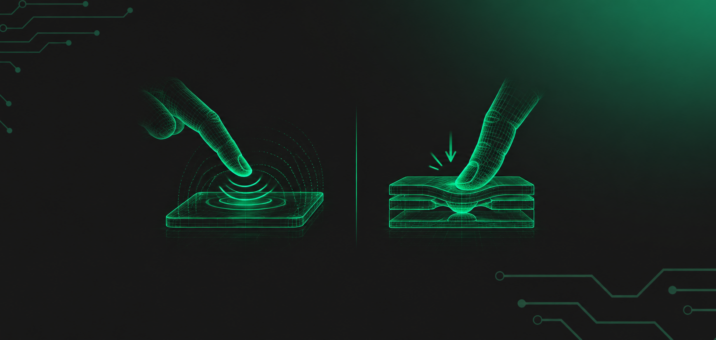
Equipped with optical bonding technology, our touch panels ensure accurate transmission of commands to the HMI system. The elimination of gaps between screen layers not only improves the readability of the interface but also increases the control precision, which is especially important in industrial environments. Our protective coatings and EMI/ESD shielding systems guarantee the stable operation of the entire control system.
Membrane keyboards manufactured by Qwerty are also an essential part of HMIs. Their design, based on high-quality UV-coated polyester films, provides operators with confidence in controlling industrial processes. Thoughtful placement of function keys and clear graphics make it easy to operate complex automation systems.
The most important part of designing HMI components is understanding the entire control system. That’s why we precede each order implementation with a thorough analysis of process characteristics and technical requirements. This allows us to create panels and keyboards that work effectively with the rest of the HMI system components, giving operators full control over the production process.